Showing posts with label Wales. Show all posts

Sunday, 22 March 2009

Gower Peninsula: the Verry Volk

The Gower Peninsula is a region rich in folklore. One of its more endearing legends, is that of the Gower Verry Volk - fairy folk. Local mythology describes these little people as capricious, lively, and fond of music, dancing and general merriment. W. Y. Evans-Wentz gave an interesting insight into the lore of the Verry Volk, in this excerpt from his book, The Fairy Faith in Celtic Countries, now in the public domain, due to antiquity.

In the Gower Peninsula, Glamorganshire

Our investigations in Glamorganshire cover the most interesting part, the peninsula" of Gower, where there are peculiar folklore conditions, due to its present population being by ancestry English and Flemish as well as Cornish and Welsh. Despite this race admixture, Brythonic beliefs have generally survived in Gower even among the non-Cults; and because of the Cornish element there are pixies, as shown by the following story related to me in Swansea by Mr. —, a well-known mining engineer:

Pixies

"At Newton, near the Mumbles (in Gower), an old woman, some twenty years ago, assured me that she had seen the pixies. Her father's grey mare was standing in the trap before the house ready to take some produce to the Swansea market, and when the time for departure arrived the pixies had come, but no one save the old woman could see them. She described them to me as like tiny men dancing on the mare's back and climbing up along the mare's mane. She thought the pixies some kind of spirits who made their appearance in early morning; and all mishaps to cows she attributed to them."

Testimony from an Archaeologist

The Rev. John David Davis, rector of Llanmadoc and Cheriton parishes, and a member of the Cambrian Archaeological Society, has passed many years in studying the antiquities and folklore of Gower, being the author of various antiquarian works; and he is without doubt the oldest and best living authority to aid us. The Rector very willingly offers this testimony:

Pixies and "Verry Volk"

"In this part of Gower, the name Tylwyth Teg is never used to describe fairies; Verry Volk is used instead. Some sixty years ago, as I can remember, there was belief in such fairies here in Gower, but now there is almost none. Belief in apparitions still exists to some extent. One may also hear of a person being pixy-led; the pixies may cause a traveller to lose his way at night if he crosses a field where they happen to be. To take your coat off and turn it inside out will break the pixy spell. (1)

The Verry Volk were always little people dressed in scarlet and green; and they generally showed themselves dancing on moonlight nights. I never heard of their making changelings, though they had the power of doing good or evil acts, and it was a very risky thing to offend them. By nature they were benevolent."

(1) The same remedy is prescribed in Brittany when mischievous lutins or corrigans lead a traveller astray, in Ireland when the good people lead a traveller astray; and at Rollright, Oxfordshfre, England, an old woman told me that it is efficacious against being led astray through witchcraft. Obviously the fairy and witch spell are alike.

A "Verry Volk" Feast

"I heard the following story many years ago: The tenant on the Eynonsford Farm here in Gower had a dream one night, and in it thought he heard soft sweet music and the patter of dancing feet. Waking up, he beheld his cow-shed, which opened off his bedroom, filled with a multitude of little beings, about one foot high, swarming all over his fat ox, and they were preparing to slaughter the ox. He was so surprised that he could not move. In a short time the Verry Volk had killed, dressed, and eaten the animal. The feast being over, they collected the hide and bones, except one very small leg-bone which they could not find, placed them in position, then stretched the hide over them; and, as the farmer looked, the ox appeared as sound and fat as ever, but when he let it out to pasture in the morning he observed that it had a slight lameness in the leg lacking the missing bone." (1)

(1) The same sort of a story as this is told in Lower Brittany, where the corrigans or lutins slaughter a farmer's fat cow or ox and invite the farmer to partake of the feast it provides. If he does so with good grace and humour, he finds his cow or ox perfectly whole in the morning, but if he refuses to join the feast or joins it unwillingly, in the morning he is likely to find his cow or ox actually dead and eaten.

Fairies among Gower English Folk

The population of the Llanmadoc region of Gower are generally English by ancestry and speech; and not until reaching Llanmorlais, beyond Llanridian, did I find anything like an original Celtic and Welsh-speaking people, and these may have come into that part within comparatively recent times; and yet, as the above place-names tend to prove, in early days all these regions must have been Welsh.

It may be argued, however, that this English-speaking population may be more Celtic than Saxon, even though emigrants from England. In any case, we can see with interest how this so-called English population now echo Brythonic beliefs which they appear to have adopted in Gower, possibly sympathetically through race kinship; and the following testimony offered by Miss Sarah Jenkins, postmistress of Llanmadoc, will enable us to do so:

Dancing with Fairies

"A man, whose Christian name was William, was enticed by the fairy folk to enter their dance, as he was on his way to the Swansea market in the early morning. They kept him dancing some time, and then said to him before they let him go, "Will dance well; the last going to market and the first that shall sell."

And though be arrived at the market very late, be was the first to sell anything."

Fairy Money

"An old woman, whom I knew, used to find money left by the fairies every time they visited her house. For a long time she observed their request, and told no one about the money; but at last she told, and so never found money afterwards.

Nature of Fairies

The fairies (verry volk) were believed to have plenty of music and dancing. Sometimes they appeared dressed in bright red. They could appear and disappear suddenly, and no one could tell how or where."
Sadly, there have been no recent reports of any Verry Volk sightings on the Gower Peninsula. Local lore blames this fact on the coming of the motor car, the general modernisation of the peninsula, as well as the massive influx of visitors into this once remote region. According to local mythology, the last known appearance of the Verry Volk, was at Lagadantra farm.

Lagadantra lies at the end of the narrow lane that runs past St. Madoc's church, in the village of Llanmadoc. The farm is in a remote location, close to the dunes of Broughton Bay. Legend relates how the farmer's wife one day received a visit from a peculiar-looking and diminutive elderly woman. The visitor requested the loan of a sieve, in order to pan for gold. The farmer's wife said she didn't have a sieve, but the old woman reminded her that she had one which she used to strain hops.

The farmer's wife began to suspect her strange-looking visitor, with a seeming sixth sense, was in fact one of the verry volk. After all, how else could this peculiar stranger know she had a sieve, and what she used it for? Fearful of incurring the wrath of the verry volk, the farmer's wife cleaned the sieve and gave it to her visitor.

The old woman returned to the farm the next week, and gave the sieve back. She thanked the farmer's wife and revealed that she was, indeed, one of the Gower Peninsula's elusive verry volk. The old lady promised the farmer's wife, that in return for her kindness, Lagadantra's biggest beer barrel would never run dry - provided the latter never revealed the reason for this good fortune to another person. Like many fairy folk in different parts of the world, the secretive verry volk were said to reward those who showed them kindness, but to retract any reward if they broke their confidence.

Lagadantra's beer became the stuff of legends in more ways than one. It became known for its potency, and a capacity to inspire drinkers to dance and cavort with fairy-like zeal. Local legend relates that Lagadantra's magical beer enticed both customers and tenants away from local inns and hostelries, leaving them empty. Sadly, however, this chapter in Lagadantra's history was to be short-lived. The farmer himself became intrigued as to why the farm's biggest beer barrel was always full. Upon asking his wife, she unfortunately revealed the secret pact between her and the verry volk woman. That was the end of Lagadantra's good fortune, and the beer barrel ran dry.
Reblog this post [with Zemanta]

Gower Peninsula: Port Eynon in March

It's hard to believe that these shots were taken at Port Eynon in mid-March, just a few days ago. Temperatures were tolerable without a coat or sweater, too. The Gower Peninsula can be surprisingly warm at this time of the year, and holiday accommodation is much cheaper than when the holiday season is at its peak.


All the seafront shops, cafes and takeaways were open, so off-season visitors were well catered for. In fact, most of the cafes, etc, on Gower seem to open almost all-year round these days, something unheard of until a few years ago.


I absolutely love Port Eynon bay at this time of year. Sadly, it's a part of the Gower Peninsula that gets too crowded for my tastes during the summer. But provided you pick a nice, sunny day, Port Eynon can be a delightful and tranquil place to visit off-season, even in winter, or early spring, as it is now.
Reblog this post [with Zemanta]

Monday, 16 March 2009

Monochrome Monday: Rhossili Bay

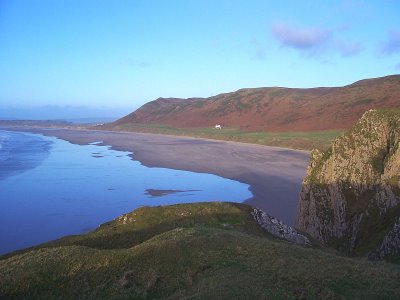
I'm a bit late for Monochrome Monday today. Never mind, better late than never. Today's shot features Rhossili Bay, on the Gower Peninsula. I've managed to capture a number of my favourite Rhossili features in this image - the dramatic cloud formations, the ever-changing patterns in the sand, and the dark shadows of the clouds, as they pass over Rhossili Down and the beach below. This shot looks better when you click on it to enlarge it.


Rhossili is such a spectacular location, even a lack of colour cannot hide its beauty. It is definitely my favourite place.

If you fancy participating in Monochrome Monday, visit Monochrome Maniacs, hosted by Aileni.
Reblog this post [with Zemanta]

Tuesday, 3 March 2009

Gower Peninsula: Pennard Cliffs

If you don't have the time or inclination to travel to the furthermost corners of the Gower Peninsula, why not visit Pennard Cliffs? It's about a 20-25 minute drive from the centre of Swansea, and offers some spectacular scenery.

Pennard Cliffs are easily reached from Swansea, via the A4118, the B4436 Bishopston Road, and then a signposted minor road to Southgate. There is ample parking at the National Trust-owned cliff-top car park, and the nearby combined shop, post office and cafe caters well for most visitors' needs.

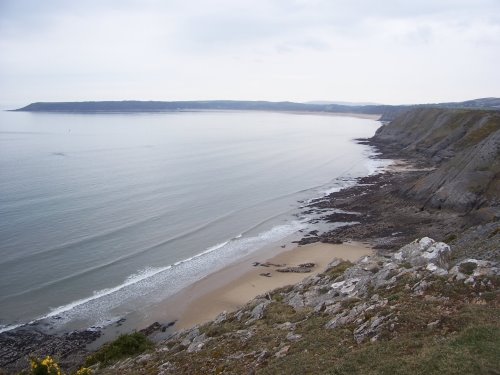
Walkers can follow a number of routes along the cliffs. If you head east, along Eastcliff, you will be rewarded with spectacular views of Pwll Du head, and will pass numerous small coves, including Foxhole and Heatherslade. If you head in the opposite direction, along Westcliff, you will enjoy views of Cefn Bryn, Pobbles Bay, Three Cliffs Bay and Oxwich. Whether you head east or west, if you look straight out to sea, on a clear day, you will also be able to see across the Bristol Channel, to the coastlines of North Devon and Somerset.

Heading west, it is possible to access the beaches at Pobbles and Three Cliffs, although part of the route is via steep sandhills, so it's not a walk for the unfit or infirm. For those who would rather not make the descent to the beaches, Westcliff not only offers spectacular views, but also, some literary points of interest. As you head along the path from the car park, towards Westcliff, you will see the Heatherslade Retirement Home. This large house used to be home to the poet, Vernon Watkins, a close friend of Dylan Thomas.

I arrived at Pennard on a nice, fairly mild, spring day. I had hoped for a little solitude, but the cliffs were inundated with visitors. I guess it's understandable, as it is one of Gower's prettiest, and most accessible locations.

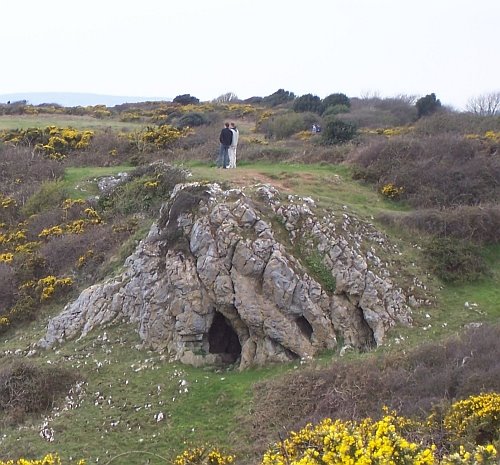
The first shot is my favourite from that day. I was still getting used to a new camera, so all my photographs that day were part of an exercise in trial and error.


I was intrigued to notice this little natural structure on the clifftop, complete with its own little fairy grotto of a cave. I was tempted to wander over and peek inside. Having recently been reading up on the folklore of the area, complete with tales of fairies, devils and half-man, half-horse entities, I spooked myself with the thought, "what if someone peeks back"? So, silly creature as I am, I contented myself with zooming in on it with my lens, rather than getting any closer.


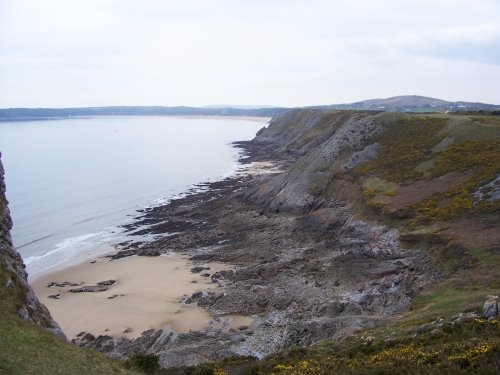
As I took this shot, I thought, one day, when I have more time, I'll head down on to the beach at Three Cliffs and Pobbles, and maybe even wander across to Oxwich.


There's actually a very rough-hewn track down the cliffs to this little beach, but I wasn't wearing hiking shoes, so I decided not to risk the descent. It's a very steep scree, and the gradient, and the looseness of the material making up the path looked like an invitation to fall headlong, so I chose to remain on the cliffs. I decided to head along Eastcliff.


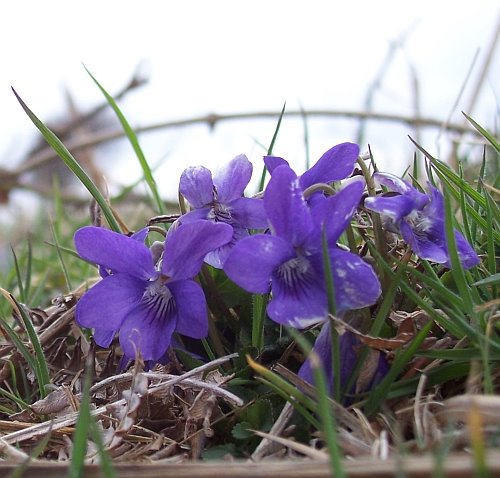
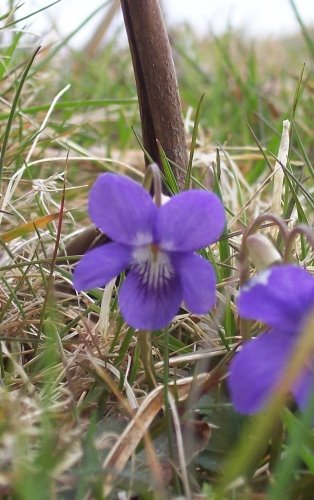
The clifftops were dotted with numerous clusters of these tiny little violets. I tried my best to get good shots of them, but trying to crouch down with an arthritic back proved a bit of a nightmare. These are the only two shots that turned out with any degree of detail or clarity - the others were disasters.


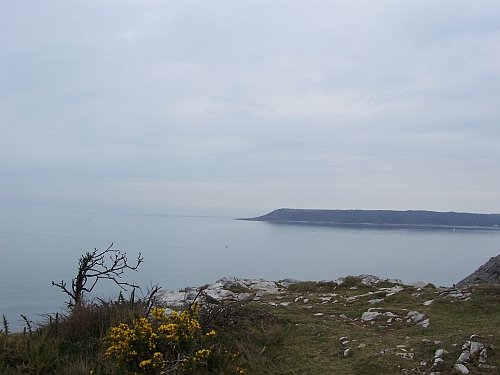
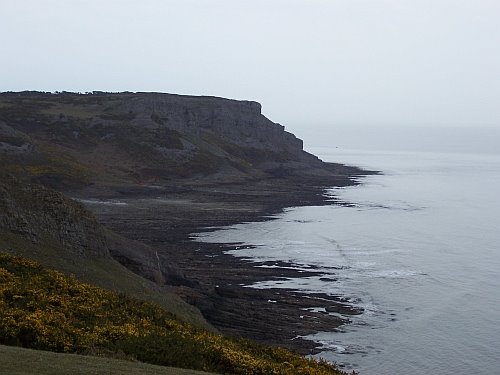
This next shot was taken looking towards Oxwich Point, the furthest headland you can see below.


Is this Pwlldu Head? I guess it must be. Pwlldu's another place on my "to visit" list, but not on one of my solo trips, way too risky given the isolation of the place. Not that I think it's a dangerous place to be - but I'm prone to falls, so don't wish to risk falling in a lonely location.


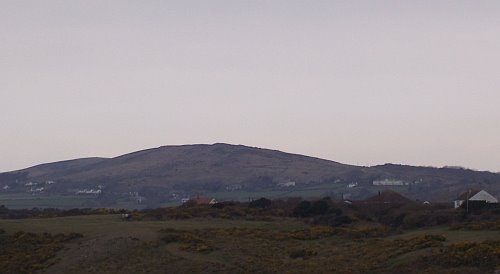
There's good old Cefn Bryn in the distance - planning a visit to Arthur's Stone soon, and maybe a Guinness in the King Arthur afterwards. But if the Bryn's suffering a cow invasion on the day, I'll be staying on the bus. Hate the smelly, poopy old things.


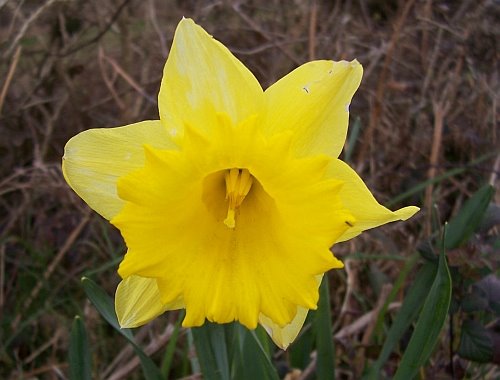
What collection of springtime images from Wales would be complete without the national flower of Wales, the daffodil?


On Saturdays, there's a very handy bus service between Oystermouth Square and Pennard Cliffs, via Caswell Bay? Here are the details of the 14B, operated by Veolia Transport [remember, Saturdays only]. It leaves Oystermouth at 11.15, 14.15 and 16.15, reaches Caswell at 11.32, 14.32 and 16.32, before terminating at Pennard Cliffs at 11.50, 14.50 and 16.50. On the return journey, times are as follows: Pennard 09.50, 11.50, 14.50, 16.50; Caswell 10.04, 12.04, 15.04, 17.04; Oystermouth 10.22, 12.22, 15.22, 17.22. It goes via Bishopston and Kittle. The timetable also says it runs via Limeslade, but the bus I got didn't. Also, the one I caught on Saturday was six or seven minutes early, so that's something to watch for.

You can get details of all services to and from Pennard Cliffs, and other Gower Peninsula locations, via the Traveline Cymru site. You can also download and print all Gower bus timetables by clicking the link on the sidebar of this page.
Reblog this post [with Zemanta]

Thursday, 29 January 2009

Gower Peninsula: Rhossili

Most of my trips to the Gower Peninsula are a spur of the moment thing. That's the advantage of living right on the peninsula's doorstep. Provided the weather isn't too hideous, I can simply hop on a bus, and find myself on the peninsula's most extreme tip within an hour.

This particular visit took place on a sunny, but incredibly cold January afternoon. The day had started off miserably, but the sun came out after lunch, so I decided to head out to Rhossili, to test out a new camera.

I didn't get there until around 15.15. I stepped off the heated bus, into a vicious chill which seemed more appropriate for Siberia than south-west Wales. I was well-insulated, but the biting wind chewed right through my two fleeces, thick, handknit sweater, thermal leggings, fleece jogging pants, two pairs of thermal socks, thermal hat and thermal gloves. I half-expected to see a herd of yak gracing the nearby hillside, instead of the resident Welsh sheep.

Unlike much of the peninsula, Rhossili faces the open Atlantic. Strong winds are common all year round, making the growing of trees nigh on impossible in and around the village. Although clumps of gorse provide some natural windbreaks along the cliffs, it can get pretty wild there, and this day was no exception. Holding the camera steady proved a difficult task. It's a tiny, flimsy thing, and even when I gripped it tightly with both hands, the wind still tossed it around.

One of the first shots I took was an experiment with the zoom function. Alas, Blogger crunches all images to a low resolution, so most of the pics here look quite blurry. You can see the original version I uploaded, by clicking on the image. This first shot, I've entitled "Rec and Wreck", as it depicts the Old Rectory at Rhossili, with the wreck of the Helvetia in the foreground.


The jackdaws were crazed that day, diving and shrieking overhead. I think they enjoyed riding the powerful air currents caused by the icy gale.


This calm view of the beach is deceptive. The icy, salt wind made my eyes water.


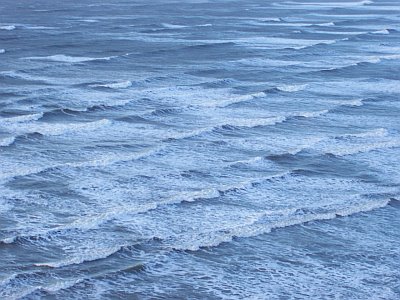
The following shots give a more accurate picture. The sea was rougher that day than I've seen it in a long time. I didn't envy the one hardy soul I saw windsurfing at Llangennith, a couple of miles along the beach from Rhossili.


The mole population of Rhossili seemed pretty well insulated against the biting chill. I made my way along the cliffs, hoping I didn't trip on a molehill, and plunge over a cliff. Despite my caution, I decided the moles were better off there, than in someone's garden, where they'll be a nuisance and end up dead at the hands of an exterminator.


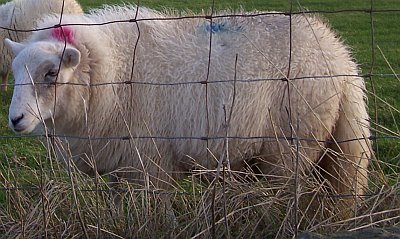
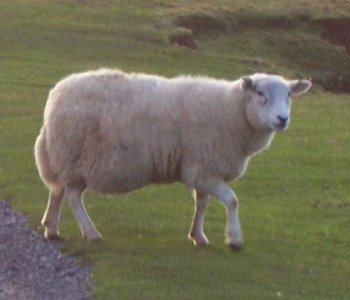
As usual, the cliffs and adjacent fields were heavily populated by sheep. Dog owners must keep dogs on a lead whilst sheep are on the cliffs, especially during lambing season, which it was. Despite their reputation for being stupid, boring creatures, I find sheep highly entertaining. Perhaps that's a peculiar Welsh trait. The woolly ones have a deranged passion for scratching their bottoms on any solid object they can find - as good a reason as any to avoid staying still too long on Rhossili cliffs. Sheep also tend to have really expressive faces and voices, and their body language says a lot. When I said "hello" to this first sheep, she eyed me with utter contempt and then showed me what she thought of me by showing me her bum. Nice.


This next one got really excited when she first saw me, and ran towards me, bleating as if I was her beloved, long-lost friend. As I tucked my hiking stick under my arm to steady the camera, her face fell to this rather woeful expression and she turned away. I think she saw me with a stick, thought it was a shepherd's staff, and mistook me for the farmer, coming to visit with a few tasty treats.


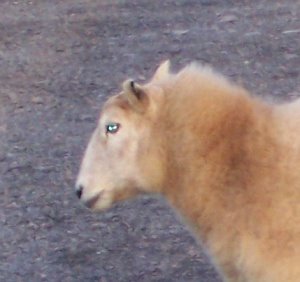
Next, I met this creature, with eyes like something from Stephen King's novel, "The Tommyknockers". Maybe she had cataracts or some other eye condition. That's not a camera flare - her eyes really did glow like that in the late afternoon sun. When she glared at me with those eyes, I felt rather scared, and then rather foolish, for being spooked by a sheep.


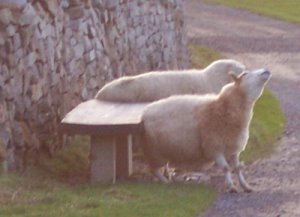
Then, I came across a meeting of the sheep equivalent of AA - but in their case, it's A**e-Scratchers Anonymous. Note the looks of relieved delight on their faces as they scratch themselves. Like I said earlier, don't stand still on Rhossili cliffs for too long, in case the AA sheep decide you look like a good scratching-post.


Here's another sheep which greeted me like a long-lost friend. When she realised she didn't know me, she trotted off, scowling, as if to say "me? talk to you? I don't think so".


I tried to get closer to this sheep, to get a better shot of her and the tidal island of Worm's Head, known to locals simply as the Worm. For some bizarre reason, I forgot about the zoom function.


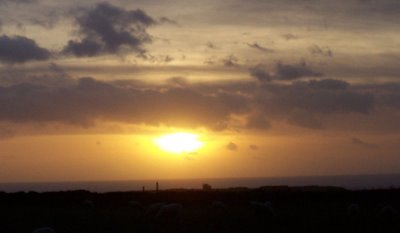
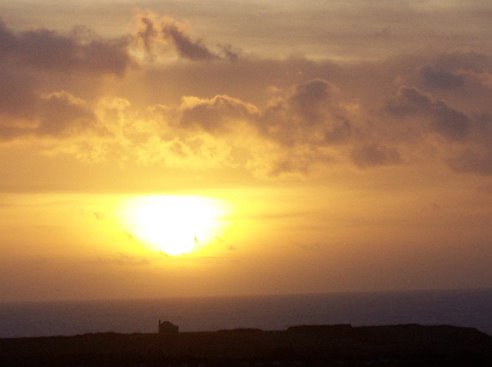
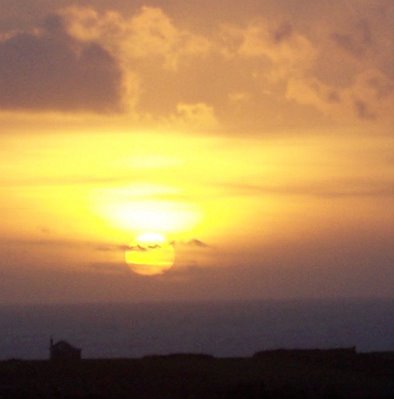
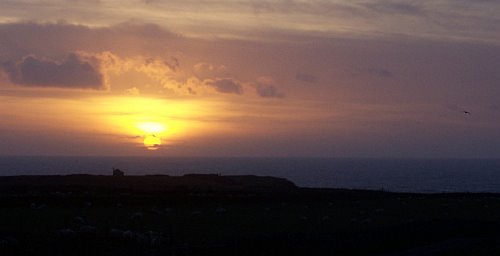
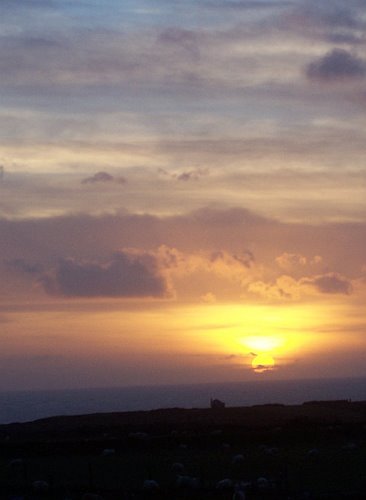
I decided I was far too cold to go any further. The Worm's Head Hotel stays closed for much of January, so there was no chance of a nice, hot coffee. So, I headed for the village's art gallery. I knew it to be a nice little gallery, and far more hospitable than the storm-swept cliffs. When I took what was meant to be my final glance towards the Worm, I spotted the beginnings of a glorious sunset. I've always been a sunset fanatic, and I relished the prospect of testing out my new camera. I forgot about the cold for a while, not even noticing it when I took off my gloves to change the camera's batteries.


I finally stopped taking pics as the sunset glow dimmed and twilight crept in. I found myself all alone, except for the sheep, and thought it best to head back to wait for my bus. Assuming it was around 16.15, I started towards the bus stop. When I checked my watch, I discovered it was 16.47. I'd missed the bus by about seven minutes, and had almost an hour to wait for the next.

I decided not to spend the next hour at the exposed bus stop at Rhossili, and sped along the main road towards the neighbouring village of Middleton. I knew I'd find a stone bus shelter there, with a nice, long bench in it, where I could retreat into a corner, out of the storm. I took my final shots of the day, looking towards Fall Bay, as I headed along the road.


I was nicely ensconced in the bus shelter, feeling safe from the storm, when I suddenly got a sense of being watched. The Gower Peninsula is famed for its ghost stories and legends, and my imagination began to get the better of me. I cast a fearful eye towards the entrance of the bus stop, and almost had a coronary. A great, shaggy head stared back at me But this was no monster, just a friendly sheep dog. With a brief woof, and a wag of its tail, it scampered off and I was alone again. Shortly afterwards, a Gower Explorer bus arrived to whisk me home. I don't normally feel the cold too much, but that day, I well and truly froze silly at Rhossili.
Reblog this post [with Zemanta]

Monday, 26 November 2007

Gower Peninsula: Kitchen Corner, Rhossili

These two shots, taken on the Gower Peninsula, show the old Rhossili Boathouse, at a location known as Kitchen Corner. I love the almost tropical look to the water in these shots, as seaweed floats near the surface, in shallow waters.


For those not familiar with the Gower Peninsula, the island in this next shot is called Worm's Head. It's a tidal island, which is connected to the mainland by a rocky, seaweed strewn causeway, for about two and a half hours either side of low tide. Once the tide comes in, it is VERY DANGEROUS to try to swim back to the shore, and many people have died doing so. If you ever get stuck on Worm's Head, just stand facing the little hut on the cliffs on the mainland. The Coastwatch people in the hut will see you and send someone to rescue you.


Reblog this post [with Zemanta]

Gower Peninsula: Foxglove at Rotherslade

The Gower Peninsula is home to a wealth of flora, including this beautiful, but highly toxic digitalis, or foxglove. I found it growing on a grass verge, near Rotherslade Bay.

Reblog this post [with Zemanta]