Showing posts with label Gower Peninsula. Show all posts

Saturday, 16 May 2009

Gower Peninsula: King Arthur restaurant review

The King Arthur Hotel is a traditional country inn. Located in Reynoldston, at the heart of the Gower Peninsula, the hotel has a reputation for good, home-cooked food, and a wide choice of traditional ales. The hotel also provides accommodation, and an al fresco dining area.

The first thing that strikes you about the King Arthur, is its warm atmosphere, and friendly, courteous staff. The menu is varied and extensive, with an emphasis on locally sourced produce, such as locally-caught seafood, and local Welsh beef. There is also an extensive wine list, a children's menu, and a generous range of vegetarian options. All dishes are very reasonably priced, and it is possible to enjoy a three-course meal, with a couple of drinks, for around £20 per head.

Our starters arrived quite quickly after ordering. I sampled the cockles and laverbread, which arrived topped with bacon and melted cheese, served in a ramekin, with a side salad, sippets of bread, and a portion of Welsh butter. Laverbread, made from seaweed, is by its very nature, a little on the gritty side. However, the four main ingredients were combined in well balanced proportions, and proved such a flavoursome combination, that the tiny bit of grittiness did not detract from my enjoyment of the dish. In fact, I thoroughly recommend it.

The starter was surprisingly filling, so I was grateful for the slight delay before the arrival of the main course. I opted for traditional pub fare - a home-cooked lasagne, with chips and side salad. My food arrived well-presented, hot, and surprisingly tasty. The lasagne was cooked to perfection, with no hint of the dryness or overcooking which so often spoils restaurant lasagne. The meat sauce filling was generous, and of an ideal consistency, neither too runny, nor too dry. The cheese sauce topping was also just right - it complemented the pasta and the meat sauce, without dominating.

The King Arthur offers a generous dessert menu, ranging from traditional treacle sponge pudding with custard, to more sophisticated options, such as apricot and almond tart. Options also include locally-produced Joe's ice cream, available in more than a dozen flavours. I opted for the Turkish delight flavour, which was delicious. My companions all ordered treacle pudding with custard. There was a fairly long delay between the ordering of the desserts, and them actually arriving at our table, but the convivial atmosphere and friendly service more than made up for the slight inconvenience.

Overall, I would thoroughly recommend the restaurant at the King Arthur Hotel. It makes for a relaxed and enjoyable dining experience. What more could you ask for than tasty food, served in a clean, cosy and welcoming traditional inn, by efficient and friendly staff?

The King Arthur Hotel, Higher Green, Reynoldston, Gower, Swansea, SA3 1AD. Tel. 01792 390775, email info@kingarthurhotel.co.uk.


Reblog this post [with Zemanta]

Sunday, 22 March 2009

Gower Peninsula: the Verry Volk

The Gower Peninsula is a region rich in folklore. One of its more endearing legends, is that of the Gower Verry Volk - fairy folk. Local mythology describes these little people as capricious, lively, and fond of music, dancing and general merriment. W. Y. Evans-Wentz gave an interesting insight into the lore of the Verry Volk, in this excerpt from his book, The Fairy Faith in Celtic Countries, now in the public domain, due to antiquity.

In the Gower Peninsula, Glamorganshire

Our investigations in Glamorganshire cover the most interesting part, the peninsula" of Gower, where there are peculiar folklore conditions, due to its present population being by ancestry English and Flemish as well as Cornish and Welsh. Despite this race admixture, Brythonic beliefs have generally survived in Gower even among the non-Cults; and because of the Cornish element there are pixies, as shown by the following story related to me in Swansea by Mr. —, a well-known mining engineer:

Pixies

"At Newton, near the Mumbles (in Gower), an old woman, some twenty years ago, assured me that she had seen the pixies. Her father's grey mare was standing in the trap before the house ready to take some produce to the Swansea market, and when the time for departure arrived the pixies had come, but no one save the old woman could see them. She described them to me as like tiny men dancing on the mare's back and climbing up along the mare's mane. She thought the pixies some kind of spirits who made their appearance in early morning; and all mishaps to cows she attributed to them."

Testimony from an Archaeologist

The Rev. John David Davis, rector of Llanmadoc and Cheriton parishes, and a member of the Cambrian Archaeological Society, has passed many years in studying the antiquities and folklore of Gower, being the author of various antiquarian works; and he is without doubt the oldest and best living authority to aid us. The Rector very willingly offers this testimony:

Pixies and "Verry Volk"

"In this part of Gower, the name Tylwyth Teg is never used to describe fairies; Verry Volk is used instead. Some sixty years ago, as I can remember, there was belief in such fairies here in Gower, but now there is almost none. Belief in apparitions still exists to some extent. One may also hear of a person being pixy-led; the pixies may cause a traveller to lose his way at night if he crosses a field where they happen to be. To take your coat off and turn it inside out will break the pixy spell. (1)

The Verry Volk were always little people dressed in scarlet and green; and they generally showed themselves dancing on moonlight nights. I never heard of their making changelings, though they had the power of doing good or evil acts, and it was a very risky thing to offend them. By nature they were benevolent."

(1) The same remedy is prescribed in Brittany when mischievous lutins or corrigans lead a traveller astray, in Ireland when the good people lead a traveller astray; and at Rollright, Oxfordshfre, England, an old woman told me that it is efficacious against being led astray through witchcraft. Obviously the fairy and witch spell are alike.

A "Verry Volk" Feast

"I heard the following story many years ago: The tenant on the Eynonsford Farm here in Gower had a dream one night, and in it thought he heard soft sweet music and the patter of dancing feet. Waking up, he beheld his cow-shed, which opened off his bedroom, filled with a multitude of little beings, about one foot high, swarming all over his fat ox, and they were preparing to slaughter the ox. He was so surprised that he could not move. In a short time the Verry Volk had killed, dressed, and eaten the animal. The feast being over, they collected the hide and bones, except one very small leg-bone which they could not find, placed them in position, then stretched the hide over them; and, as the farmer looked, the ox appeared as sound and fat as ever, but when he let it out to pasture in the morning he observed that it had a slight lameness in the leg lacking the missing bone." (1)

(1) The same sort of a story as this is told in Lower Brittany, where the corrigans or lutins slaughter a farmer's fat cow or ox and invite the farmer to partake of the feast it provides. If he does so with good grace and humour, he finds his cow or ox perfectly whole in the morning, but if he refuses to join the feast or joins it unwillingly, in the morning he is likely to find his cow or ox actually dead and eaten.

Fairies among Gower English Folk

The population of the Llanmadoc region of Gower are generally English by ancestry and speech; and not until reaching Llanmorlais, beyond Llanridian, did I find anything like an original Celtic and Welsh-speaking people, and these may have come into that part within comparatively recent times; and yet, as the above place-names tend to prove, in early days all these regions must have been Welsh.

It may be argued, however, that this English-speaking population may be more Celtic than Saxon, even though emigrants from England. In any case, we can see with interest how this so-called English population now echo Brythonic beliefs which they appear to have adopted in Gower, possibly sympathetically through race kinship; and the following testimony offered by Miss Sarah Jenkins, postmistress of Llanmadoc, will enable us to do so:

Dancing with Fairies

"A man, whose Christian name was William, was enticed by the fairy folk to enter their dance, as he was on his way to the Swansea market in the early morning. They kept him dancing some time, and then said to him before they let him go, "Will dance well; the last going to market and the first that shall sell."

And though be arrived at the market very late, be was the first to sell anything."

Fairy Money

"An old woman, whom I knew, used to find money left by the fairies every time they visited her house. For a long time she observed their request, and told no one about the money; but at last she told, and so never found money afterwards.

Nature of Fairies

The fairies (verry volk) were believed to have plenty of music and dancing. Sometimes they appeared dressed in bright red. They could appear and disappear suddenly, and no one could tell how or where."
Sadly, there have been no recent reports of any Verry Volk sightings on the Gower Peninsula. Local lore blames this fact on the coming of the motor car, the general modernisation of the peninsula, as well as the massive influx of visitors into this once remote region. According to local mythology, the last known appearance of the Verry Volk, was at Lagadantra farm.

Lagadantra lies at the end of the narrow lane that runs past St. Madoc's church, in the village of Llanmadoc. The farm is in a remote location, close to the dunes of Broughton Bay. Legend relates how the farmer's wife one day received a visit from a peculiar-looking and diminutive elderly woman. The visitor requested the loan of a sieve, in order to pan for gold. The farmer's wife said she didn't have a sieve, but the old woman reminded her that she had one which she used to strain hops.

The farmer's wife began to suspect her strange-looking visitor, with a seeming sixth sense, was in fact one of the verry volk. After all, how else could this peculiar stranger know she had a sieve, and what she used it for? Fearful of incurring the wrath of the verry volk, the farmer's wife cleaned the sieve and gave it to her visitor.

The old woman returned to the farm the next week, and gave the sieve back. She thanked the farmer's wife and revealed that she was, indeed, one of the Gower Peninsula's elusive verry volk. The old lady promised the farmer's wife, that in return for her kindness, Lagadantra's biggest beer barrel would never run dry - provided the latter never revealed the reason for this good fortune to another person. Like many fairy folk in different parts of the world, the secretive verry volk were said to reward those who showed them kindness, but to retract any reward if they broke their confidence.

Lagadantra's beer became the stuff of legends in more ways than one. It became known for its potency, and a capacity to inspire drinkers to dance and cavort with fairy-like zeal. Local legend relates that Lagadantra's magical beer enticed both customers and tenants away from local inns and hostelries, leaving them empty. Sadly, however, this chapter in Lagadantra's history was to be short-lived. The farmer himself became intrigued as to why the farm's biggest beer barrel was always full. Upon asking his wife, she unfortunately revealed the secret pact between her and the verry volk woman. That was the end of Lagadantra's good fortune, and the beer barrel ran dry.
Reblog this post [with Zemanta]

Gower Peninsula: food

The Gower Peninsula offers holidaymakers and locals many gastronomic delights. Too many, in fact, to cover in one article. So, over the coming weeks and months, I'll be publishing various food-themed articles, which, hopefully, will add up to a useful guide for locals and visitors alike.

One good thing about visiting, or living close to a place like the Gower Peninsula, is the wide variety of locally produced food available. Many of the local farms grow and sell their own vegetables, fruit, meat, dairy and other produce, offering a nice alternative to the mass-produced goods available in local groceries and supermarkets.

One place I hope to visit soon, as I'll have access to a car, is Crickton Farm Shop, located at Crickton Farm in Llanrhidian, which is on North Gower. I believe the shop is open to the public on Fridays, Saturdays, and Sundays. The farm is quite easy to find. If you approach the village of Llanrhidian via the North Gower road from Swansea, on the left-hand side, you will see signs directing you to the farm, just before you enter the village. The shop sells a wide choice of vegetables grown at the farm, as well as Welsh cheeses, beers and preserves. If you have any queries about the shop and its produce, you can call 01792 390136.

Another place I'm hoping to visit this year, is Nicholston Farm, located just off the South Gower road, between Penmaen and Oxwich. I've passed there many a time and seen their enticing sign, but having always been dependent upon public transport, I've never stopped off and visited. There is a farm shop, as well as a cafe that comes highly recommended. The farm also offers you the chance to pick your own fruit and vegetables, especially soft fruits. The availability of pick your own is roughly 10th June to 25th July. I understand the farm often also has plants for sale in the spring/early summer. For further information, call 01792 371209, or check out the website (link above).

If you like lamb, you might want to try some award-winning Gower Salt Marsh lamb from Weobley Castle Farm. The sheep graze on marshland near to Weobley Castle, and thrive on a unique diet of saltmarsh grasses, samphire, sorrel, sea lavender and thrift. I'm reliably informed that this diet contributes to a fine-flavoured lamb, much sought after by top chefs and gourmets alike. The lamb is delivered to order, within 24 hours. If you wish to collect the lamb directly from the farm, this may only be done by prior arrangement. Contact information is available here.

The above are just a sample of what the Gower Peninsula has to offer in the way of fine local produce. I hope to uncover information about more local food producers over the coming weeks and months, and will be certain to pass my findings on. Happy dining!

Reblog this post [with Zemanta]

Gower Peninsula: new buses for Gower Explorer route

The Gower Explorer bus timetable (link opens PDF) is to be expanded, from April 2009. This is a much-needed expansion, and it's good to see such changes being implemented.

From April 12th, a new early walkers' service, serving South Gower, will run on Sundays and Bank Holidays. This additional service will leave Swansea's Quadrant bus station at 9am on Sundays and Bank Holidays, and will serve Oxwich Bay, Port Eynon and Rhossili. The bus will return from Rhossili at 10.07am, via Oxwich Bay, to Swansea.

From April 14th, a new late bus will be introduced, serving South Gower. Every day (except Sundays and Bank Holidays), this new service will leave Port Eynon at 8.37pm, Rhossili at 8.50pm, and Oxwich at 9.10pm, and will end its journey at Swansea's Quadrant bus station.

It's good to see the Gower Explorer bus service being expanded in this way. It means people can now enjoy a day out on Gower, and unwind in a pub or restaurant afterwards, without having to rush off for a ridiculously early last bus.

More information on the new Gower bus services.

Gower Peninsula: Rhossili in March

After my visit to Port Eynon, a few days ago, I decided to venture further along the Gower Peninsula, to Rhossili. It was almost as hazy at Rhossili, as it had been at Port Eynon.

My main reason for heading to Rhossili, was to get some close shots of the Old Rectory. Alas, as on every other occasion I've tried to get such shots, the area close to the Rectory was overrun with cattle. I could see some walkers in the distance, who passed the cows without incident.


As I edged further along the path towards the Rectory, I decided not to risk passing the cows, as I had my little dog with me, and didn't know how he and the cows would react to one another. Cows can sometimes behave aggressively to dogs and their owners, so it was a risk I wasn't prepared to take.


I headed back uphill, passing this old building. For some reason, I had it fixed in my head that it's an old woollen mill, but further research suggests it's the old rocket shed, used by the Rhossili rocket crew, the forerunners of the present-day coastguard. If you're interested in shipwrecks around the Gower coast, I suggest you visit Chris Elphick's excellent Welcome to Gower site. He has numerous articles about the various shipwrecks and their visible remains, around the Gower coast.


Passing a hedgerow, I managed to snap a shot of a male house sparrow, who seemed blissfully unaware of my presence.


I'll end this post with a shot of my little Shih Apso (Shih Tzu-Lhasa Apso hybrid), Jake, enjoying the view across Rhossili Bay.


If you haven't visited the Gower Peninsula yet, add it to your to-do list. You won't regret it!
Reblog this post [with Zemanta]

Gower Peninsula: Port Eynon in March

It's hard to believe that these shots were taken at Port Eynon in mid-March, just a few days ago. Temperatures were tolerable without a coat or sweater, too. The Gower Peninsula can be surprisingly warm at this time of the year, and holiday accommodation is much cheaper than when the holiday season is at its peak.


All the seafront shops, cafes and takeaways were open, so off-season visitors were well catered for. In fact, most of the cafes, etc, on Gower seem to open almost all-year round these days, something unheard of until a few years ago.


I absolutely love Port Eynon bay at this time of year. Sadly, it's a part of the Gower Peninsula that gets too crowded for my tastes during the summer. But provided you pick a nice, sunny day, Port Eynon can be a delightful and tranquil place to visit off-season, even in winter, or early spring, as it is now.
Reblog this post [with Zemanta]

Wednesday, 18 March 2009

Gower Peninsula: Travelling by public transport

Much of the Gower Peninsula is served by the award-winning Gower Explorer bus service, operated by Veolia Cymru. Popular locations served by the Gower Explorer buses include Rhossili, Port Eynon, Reynoldston, Oxwich, Penmaen, Parkmill, Llangennith, Llanmadoc, Penclawdd, and Llanrhidian. The cheapest way to travel around the Gower Peninsula is to purchase a Gower Explorer day ticket, which I believe currently costs £4.00.

Anyone visiting Gower should note that Gower destinations closer to Swansea city centre, are served by First Cymru buses. Such destinations include Mumbles, Oystermouth, Swansea Bay, Caswell, Langland, Bishopston and Pennard. Tickets purchased on a First Cymru service bus cannot be used on the Gower Explorer network, or vice versa, as they are two separate bus companies. First Cymru tickets can be used on a small number of Veolia-operated routes within Swansea city, namely the Cwmdonkin service (8 and 9), the Northill service (11), and services 144, 145 and 146, connecting various parts of the city with Morriston Hospital. No Veolia ticket, however, may be used on any First Cymru service.

Download current Gower Explorer timetables and pocket guides.

Visit First Cymru, for details of services to Mumbles, Caswell, Langland, Bishopston and Pennard (2, 2A, 2B, 3/3A, 14).


Update: new bus services for the Gower Peninsula.
Reblog this post [with Zemanta]

Monday, 16 March 2009

Gower Peninsula: Spring Heeled Jack

A few years ago, I wrote an article about the apparent arrival of Spring-heeled Jack on the Gower Peninsula, mainly in the areas around Port Eynon, and Overton cliffs. I have reproduced the article, in its entirety, below, with the addition of some images not included in the original.

Introduction

Horatio Tucker was the first local historian to revive the memory of Spring-heeled Jack's activities on the Gower Peninsula, in fairly recent times. He recounted how an other-worldly apparition terrorised the inhabitants of Port Eynon and Overton, in his 1951 book, Gower Gleanings. The Gower Society investigated a little further, and Clifford Bevan gave the results of his findings in 'Spring-heeled Jack': A Nineteenth-century Gower Phenomenon. The article appeared in Volume 52 of the Gower Journal, published in 2001.

General Background

The Spring-heeled Jack phenomenon first manifested in London in the 1830s. Many theories were expounded as to Jack’s origins. Some believed he was an unearthly beast, others suggested he was from another planet, and others still thought he was the devil himself. More pragmatic Londoners suggested he was a man in a costume, carrying some kind of new-fangled, concealed apparatus which allowed him to leap great distances. He almost sounded like an evil, nineteenth century forerunner of James Bond.

Popular depiction of Spring-Heeled Jack

Jack was described as tall, slender, and powerfully built, always clad in a black cloak. He was reputedly able to leap vertically in the air, as high as twenty or thirty feet, vaulting high walls, hedges and railings. Witnesses claimed the apparition possessed huge, pointy ears, and red, glowing eyes. He also reportedly spat blue-white flames at his victims.

His first attack was in Lavender Hill, south east London, in October 1837. He vaulted three metre high railings, and attacked a group of people, before conducting an act best described as an indecent assault. Jack tore the blouse off a woman in the group, and intimately fondled her. Another female victim claimed he kissed and fondled her, suggesting a rather more earthly motivation for his attacks, than a supernatural one. Spring-heeled Jack became notorious as his attacks increased, with rumours abounding that yet another woman had been blinded by the blue-white flames he spat at her. When he attacked a woman at Clapham, he left ground evidence which suggested he was using some kind of sprung apparatus to carry out his leaps.

At the start of 1838, Jack was declared a public menace by London’s Lord Mayor. A band of men formed to hunt him down, amongst their number an ageing Duke of Wellington. However, Jack eluded them and continued to terrorise women until 1843.

Spring-heeled Jack, as depicted on the cover of a Penny Dreadful

In 1845, he resurfaced across the Atlantic, in New York City. He leapt at a prostitute, as she solicited for business on a bridge, breathing blue-white flames at her. She was so terrified, she leapt off the bridge to her death.

After the New York incident, Spring-heeled Jack retired for several years, until his re-emergence in 1877. He terrorised London yet again, before moving on to Aldershot camp, where he attacked a young soldier with his fiery breath. He moved on to Lincolnshire, and then made an appearance in Birmingham in 1879. All sightings of Jack were documented in the national, as well as local press.

Spring-heeled Jack arrives on Gower

Spring-heeled Jack arrived on Gower, late one autumn in the 1880s. Clifford Bevan, in his nineties at the time the article was published, relates how Jack made his debut one night when the moon was bright. Two farm lads at Overton Farm were the first to spot the fearsome figure. At the end of a hard day’s toil, the lads were no doubt cold, tired and hungry. As they stood at the bottom of a steep field, they looked up onto the field’s uppermost level, and saw a ghastly, black-cloaked apparition looming.

The countryside can seem most eerie when bathed in blue-white moonlight. Shapes innocent by day, distort into fanciful and terrifying creatures. Shadows of tiny objects take on huge and fearful proportions. Trees and bushes hold unknown terrors, as their skyward branches become the rapacious claws of crazed witches. Overton would have had no road lighting in the 1880s, or bright, electric house lights either, adding to the macabre and sinister illusion.

Rather than confront the unearthly apparition silhouetted atop the hill, the farm hands sped home, convinced Spring-heeled Jack was springing at their own heels. When they reached the farmhouse, they sought sanctuary in the ingle nook of the hearth, quaking with terror and refusing to emerge until daylight.

Their initial sighting triggered a whole spate of similar apparitions. High vantage points around Port Eynon and Overton, became Jack's theatre stages, where he performed to an aghast audience . His terrified witnesses watched as he leapt wildly over gates, hedges and other such constructions. So fearful was his performance, that women would not venture out at night, and some of the local farmers began searching for him, armed with shotguns.

However, Clifford Bevan's own father put an end to Jack’s reign of terror. Spotting the fiend one night, the elder Mr. Bevan chased him into a field. During a brief altercation, he discovered Jack to be no monster, but a local wag having some fun. Jack's fearsome black form was an illusion created with the aid of a stout oilskin coat and sou'wester. Not wishing to be exposed, 'Jack' threatened to beat his adversary with a heavy iron plough trace. To avoid the risk of serious injury or death, Mr. Bevan agreed not to expose him, but insisted he gave up his campaign of terror. 'Jack' agreed, and no more was seen of the monster on the Gower Peninsula.

News spread quickly across the peninsula, that the fearless Mr. Bevan had vanquished the monster. His victory was so celebrated that he found himself mobbed in the centre of Swansea, by unwitting Gower folk, who were relieved at Jack's demise.

When I first read Clifford Bevan’s article, I was a little disappointed, having searched for it for a long time. It was short, and there was no real phenomenon after all, just a prankster in a long coat. But disappointment soon turned to delight.

This little anecdote sheds an interesting light on the character of yesteryear's Gower. Life was very tough by today's standards, with many people, men, women and children, turning in twelve hour days, often longer, six or seven days a week. No wonder these people also chose to play hard. It was also a time when money was scarce, so many bargains were struck, e.g. "let me plant my potatoes in your field and I'll give you a sack or two in return". The bargain struck between Mr. Bevan and 'Jack' worked to both their advantages. 'Jack' went unpunished for his mischief, his identity remaining secret, and Mr. Bevan was hailed a hero for routing him.

Common sense dictates that the legend of Spring-heeled Jack is just a myth. The initial sightings suggest he was an unscrupulous prankster with a tendency towards sexual deviance. Coincidentally, he made his appearance at a time when pulp fiction, in a form known as the penny dreadful, made popular reading. These publications featured such unearthly and fearsome characters as Varney the Vampire and the Blue Dwarf, as well as Spring-heeled Jack himself. The popular fiction of the day would have acted as great PR for the man or men behind the legend of Spring-heeled Jack. Who knows, he or they may even have been inspired by such fictional tales. Whatever the truth of the situation, the culprit or culprits must have enjoyed many a laugh at the expense of terrified citizens. However, all it took on Gower, was a fearless and pragmatic farmer, to confront and unmask the local culprit as an ordinary man, and a cowardly one at that.

Reference

Clifford Bevan
'Spring-heeled Jack': A Nineteenth-century Gower Phenomenon. Gower Journal, vol. 52, 2001.

Reblog this post [with Zemanta]

Monochrome Monday: Rhossili Bay

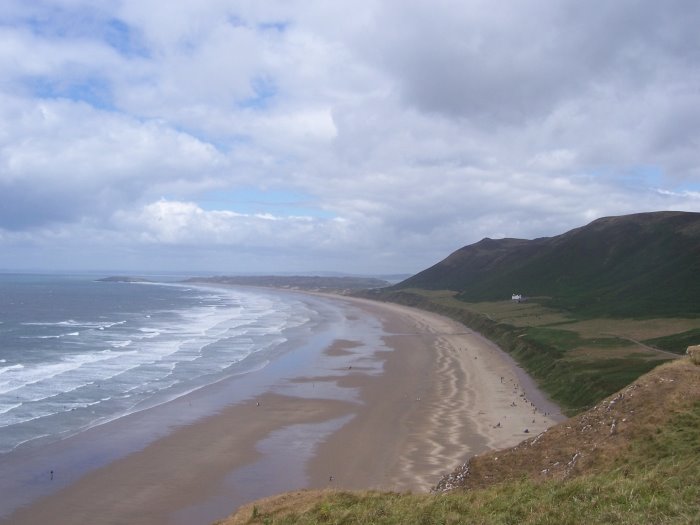
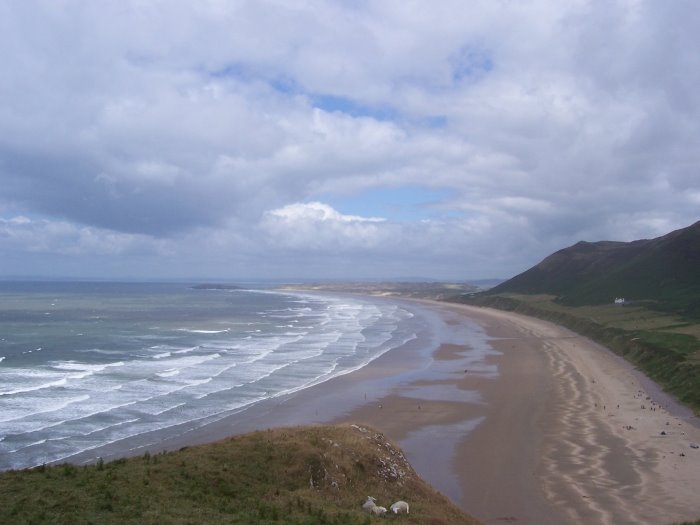
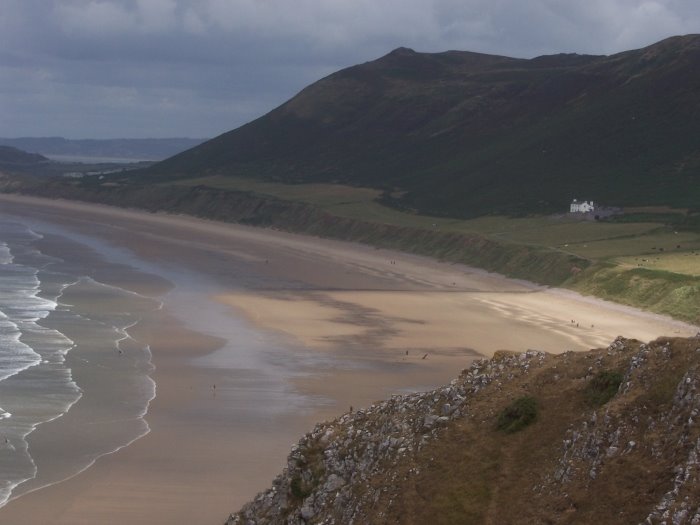
I'm a bit late for Monochrome Monday today. Never mind, better late than never. Today's shot features Rhossili Bay, on the Gower Peninsula. I've managed to capture a number of my favourite Rhossili features in this image - the dramatic cloud formations, the ever-changing patterns in the sand, and the dark shadows of the clouds, as they pass over Rhossili Down and the beach below. This shot looks better when you click on it to enlarge it.


Rhossili is such a spectacular location, even a lack of colour cannot hide its beauty. It is definitely my favourite place.

If you fancy participating in Monochrome Monday, visit Monochrome Maniacs, hosted by Aileni.
Reblog this post [with Zemanta]

Saturday, 14 March 2009

Gower Peninsula: Rhossili, Fall Bay and Kitchen Corner

I had the pleasure of visiting Rhossili on Tuesday, for the first time in over a year. I can't believe it's been that long. A number of things kept me away. First of all, I began suffering from the most hideous travel sickness, which ruined the last few trips I took to Gower. Then, we had the most appalling and relentless period of wet weather I can ever remember - we had heavy rain practically every day for several weeks. Then, I adopted a little rescue dog, who became very distressed when travelling, and I couldn't leave him home alone for more than 1-2 hours at a time. The travel sickness seems to have resolved itself, simply by me switching from opiate-based to anti-inflammatory pain killers. Sadly, the little dog I adopted had to be put to sleep less than four months after I adopted him. However, I adopted a little Shih Tzu just after Christmas - and although he huffs and puffs a little about getting on a bus, he soon settles down, and travels well.

Tuesday was a little chilly, grey and drizzly to start with, but by the time my cousin and I reached Rhossili, along with Jake, the dog, we were treated to blue skies and sunshine. I didn't have my camera with me on this occasion. I was recently mugged at knife-point, and am now reluctant to carry valuables with me. So the camera stayed at home. But I have images from a previous occasion, taken along the exact route I walked on Tuesday.

One thing I love about Rhossili beach, is the way the patterns in the sand shift - they're never the same two days in a row.


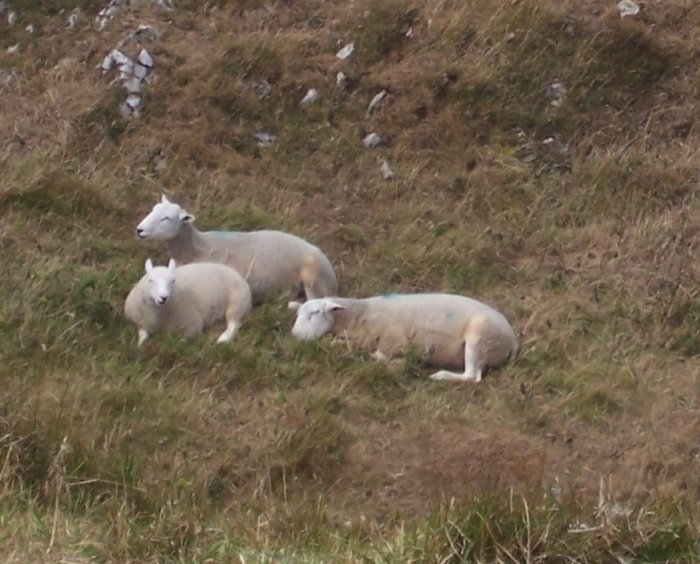
I had to keep Jake on his leash. Even though he's just a small dog, he showed an unhealthy interest in the sheep we met along the cliffs. Although he's too little to maul sheep, he could still scare them. It's still lambing season at the moment, and I would hate to be responsible for allowing my dog to scare a sheep into falling over a cliff, or aborting a lamb.


Jake

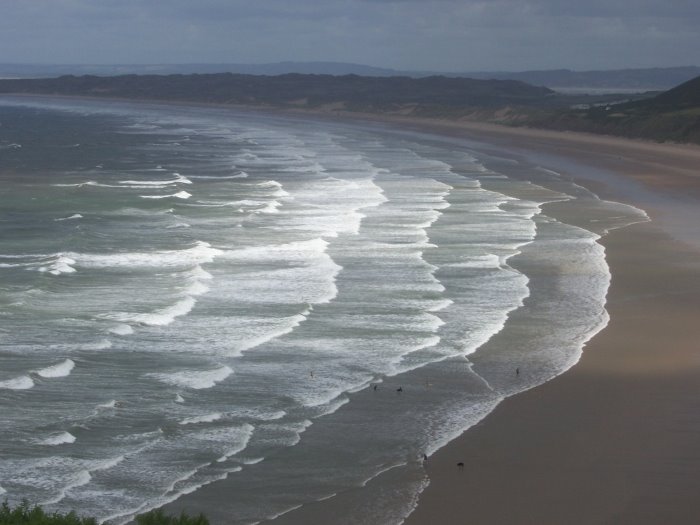
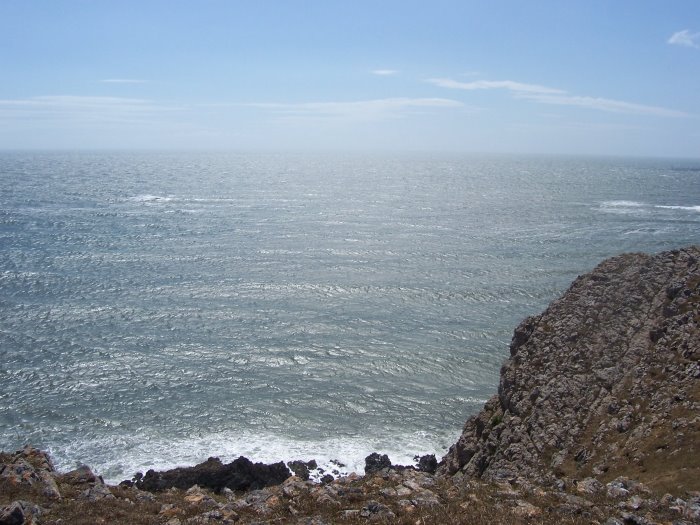
There was a strong breeze at Rhossili, but it was certainly nothing gale force. In fact, it was perfect. I love watching the white horses rushing ashore, something you won't see if the air's still. There were plenty of surfers and body-boarders around, taking advantage of the wind-whipped waves. Those unfamiliar with Rhossili should note that a strong wind can whip up here very quickly, at any time of the year. There is no large land mass anywhere between Rhossili and South America. The cliffs face the open Atlantic, and the winds can be unexpectedly cool, even at the height of summer. For that reason, it's always wise to carry an extra layer with you, so that you can keep warm, even in the summer, as the wind whips up lightning fast at times.


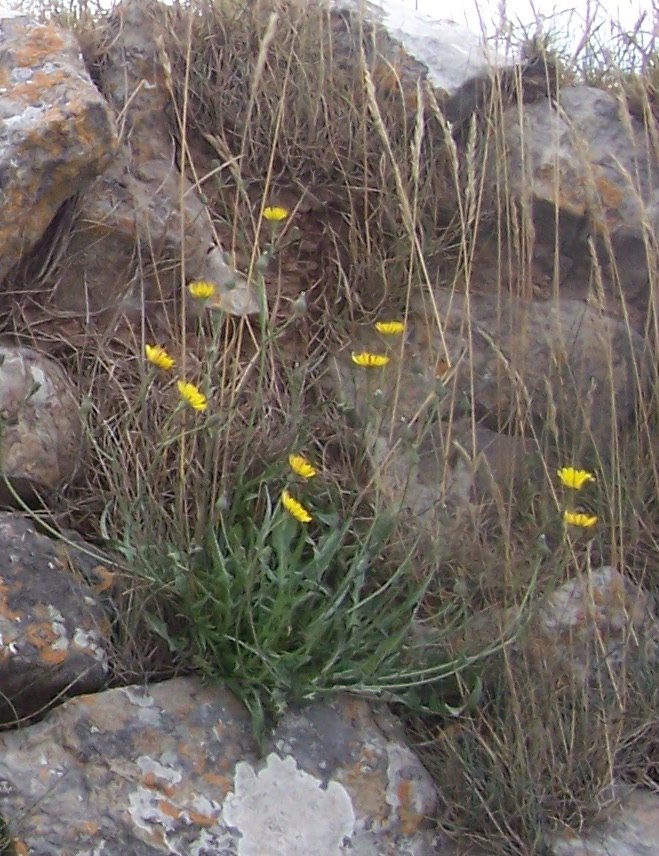
Ever since the TV gardening craze hit the UK, garden plants and designs seem to be growing ever more elaborate and exotic. I find the simplicity of our native wildflowers, and the way they'll appropriate any suitable nook or cranny to ensure their survival, far more appealing. Forget azaleas, nicotianas and cascades of multi-coloured blooms - just give me a lichen-covered drystone wall sprouting hawkweed instead. Although the hawkweed is yet to bloom at Rhossili this year, it won't be long before it does.


If you squint really hard at the following shot, you should be able to make out a few surfers along the shoreline of Rhossili Bay.


It must have been rougher at the top of Rhossili Down, than it was along the cliffs or at sea level. I had expected to see paragliders taking off from their usual launch spot, about two thirds of the way up, but I guess it was too rough for them.


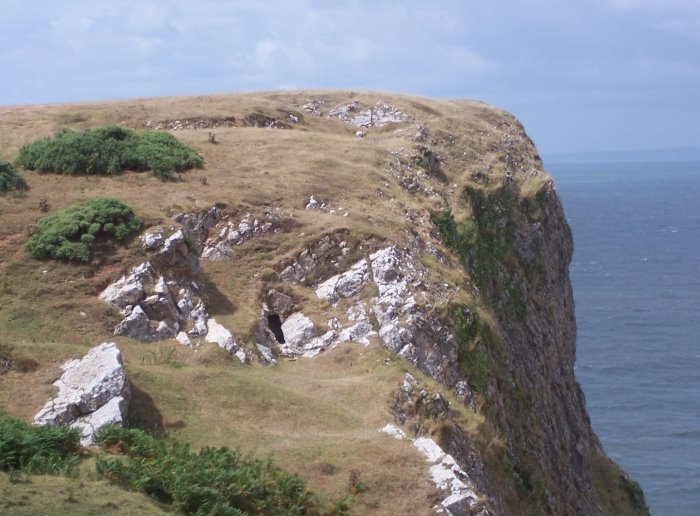
Does anyone know if this fissure in the rock is natural or man-made? I wonder if any creatures sleep in there at night? Perhaps a badger or fox has made it their home?


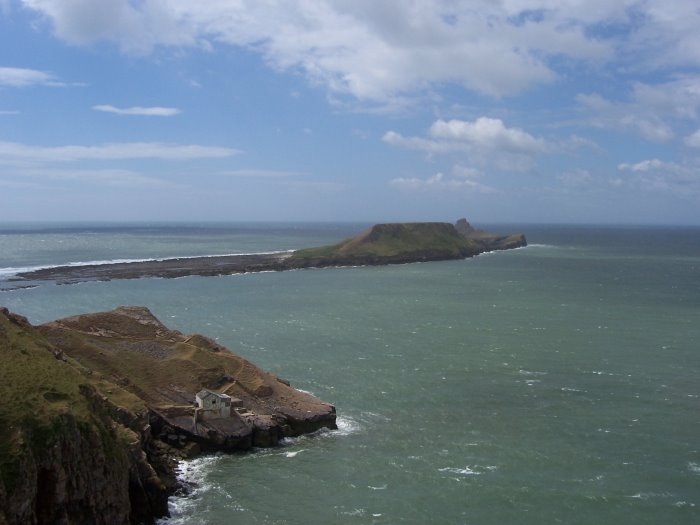
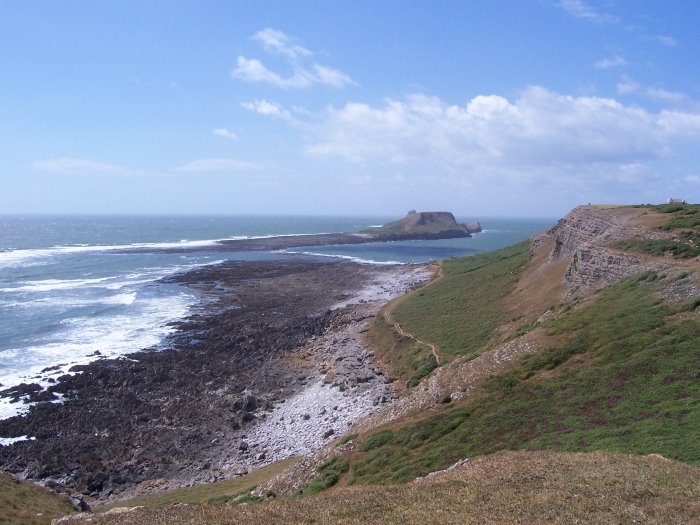
The sea is often an incredible green colour, especially going towards Worms Head, but alas, my camera never seems to do it justice.


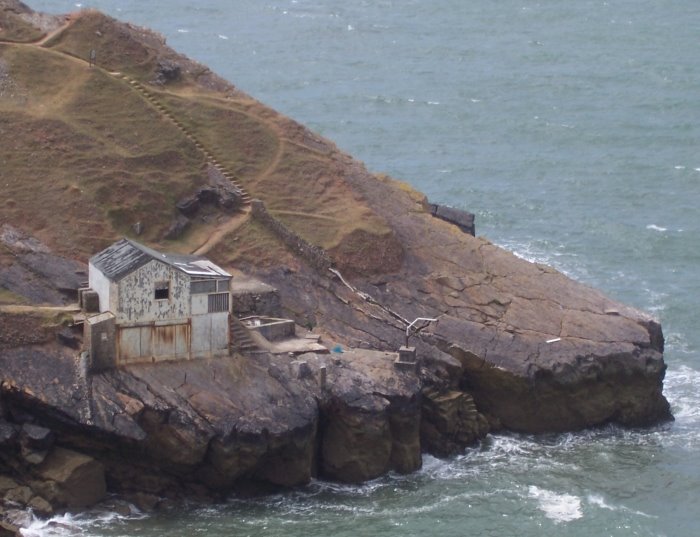
What's the history of Kitchen Corner? I'm sure I must have read it somewhere, but my mind has failed to absorb it. Does it have anything to do with the quarrying that went on along the cliffs a century or two ago? I've always been intrigued as to why there's a large tin shack and a rough-hewn little quayside, complete with its own stone staircase, in such a remote spot.


I was delighted, when we reached the old Coastguard hut overlooking the Worm, to discover that I was still pain-free and quite energetic. I decided to take my cousin, who was visiting from London, down to Fall Bay, as he's never been there.

Before long, we came to this rocky little valley, which at first, looked very treacherous. Closer inspection revealed some steep, but accessible tracks leading to the rocky shore below. However, given my intermittent and unpredictable balance problems caused by my arthritic neck, I decided to venture only a few metres down, although my cousin headed down a little further. Although there were no sheep around, I decided to keep Jake on his leash, in case he took a tumble off the cliffs.


Glancing back the way we'd just come, we were rewarded with this new and interesting view of Worm's Head. As much as I love the Worm, I've become rather sick of photographing it from the same familiar old angles, time and time again.


As we forged ahead, Wayne, my cousin, got his first glimpse of Fall Bay.


The last time I visited Fall, I was met with a chorus from these ladies, who greeted me like an old friend. "Turn the other way and enjoy the view", I urged them, but they just baa-ed back and carried on munching.


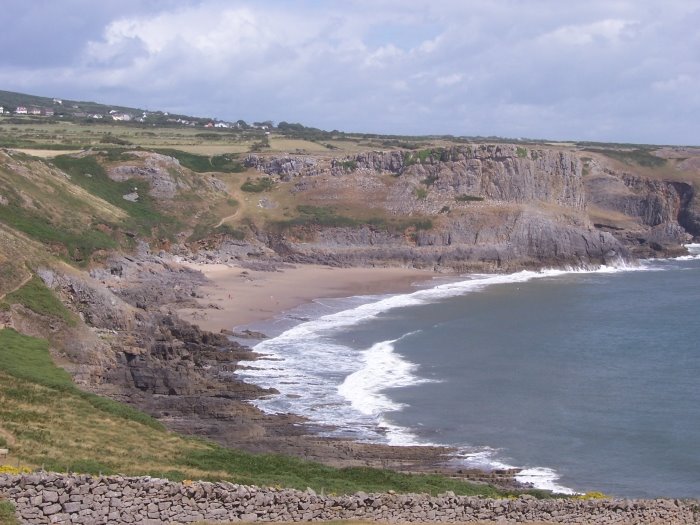
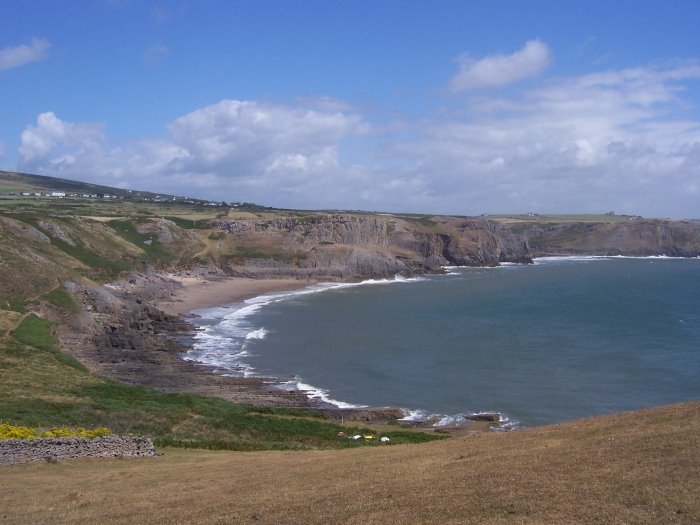
I'd forgotten what a charming little bay Fall is, with its neat, semi-circular shape. It reminds me a little of Lulworth Cove in Dorset.


I wish my camera had captured the striking visual effect of this rock formation, especially against the backdrop of the ocean. Better still, I wish I could stop blaming the camera for my own photographic inadequacies and inexperience. I really need to get over my fear of carrying my camera around with me, to try to get some better shots at Fall Bay.


I've always been intrigued by this collection of little boats, perched high and dry amongst the bracken on the cliffside. Anyone know whose they are and why they're there? There were even more there on Tuesday, as well as a few kayaks.


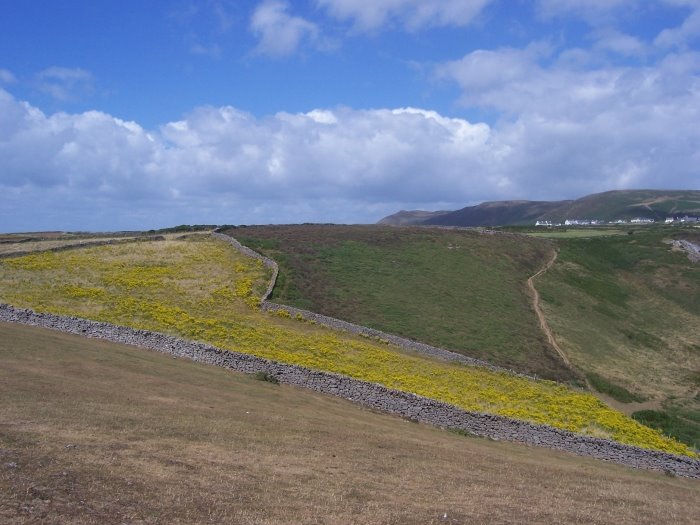
The fields near Fall Bay contained nothing more interesting than the remains of winter crops. Give it a few months, though, and there will be a swathe of golden flowers carpeting this field. Closer inspection will reveal nothing more exotic than the humble ragwort, but its visual effect, when viewed from a short distance, is stunning.


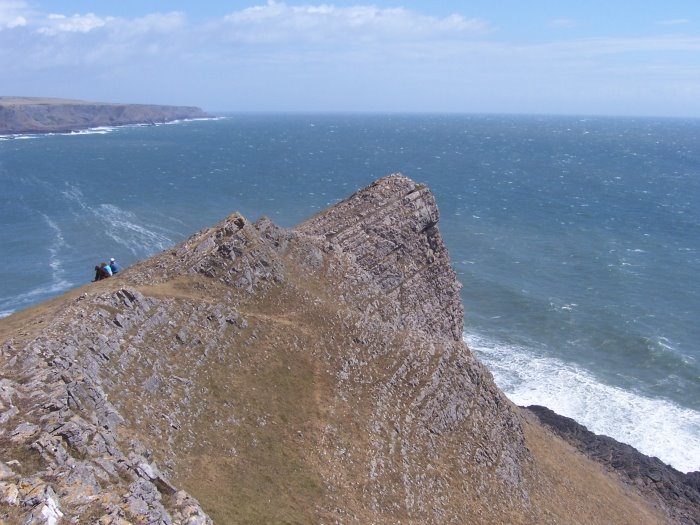
Does this amazing-looking rocky outcrop have a name? It must have been one heck of a volcanic eruption that formed this jagged peak, all those eons ago.


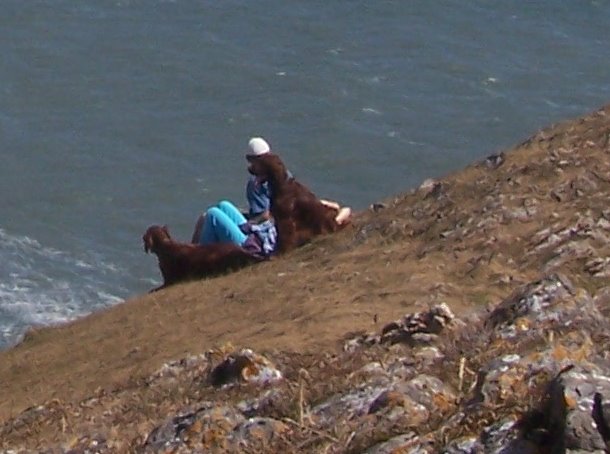
Wayne, Jake and I sat on this rocky outcrop overlooking Fall Bay, and enjoyed the late afternoon sunshine. Jake gratefully accepted some food and water, and had a little snooze. The last time I was here, I noticed a couple sitting on the jagged cliff, but I was more watchful of their restless red setters. These somewhat boisterous dogs kept making little forays across to where I was sitting, and I was getting more and more uncomfortable. Moments after I took these pics, the hounds suddenly tore towards me with great purpose, eyes blazing and tongues lolling, like something from the Hound of the Baskervilles.


I was mightily relieved when they sped right past, just a couple of feet from where I was sitting. However, my relief was shortlived. To my horror, they began worrying some sheep, snapping at them and driving them closer and closer to the edge of a sheer cliff. I immediately made the owners aware, pointing out that if the farmer came along, he would probably shoot the dogs first, and ask questions later. Fortunately, they were nice, reasonable people, who immediately brought the dogs under control.


Sadly, we could only spend a short time at Fall Bay, as we had to keep an eye on the clock. Had we missed our bus, we would have had another ninety minutes to wait. We passed through a wooden gate and followed a footpath, which skirted crop fields, en route to the village. The path was very muddy, and I almost slipped a number of times. As there were no sheep around, I let Jake off the leash for a little while. He ended up looking like a swamp monster, he became so caked with mud. But it was nothing a bath wouldn't fix, so I let him have some fun. We arrived back at Rhossili village in plenty of time, and had a soft drink in the beer garden of the Worm's Head Hotel, before heading home.

Reblog this post [with Zemanta]