The Gower Explorer bus timetable (link opens PDF) is to be expanded, from April 2009. This is a much-needed expansion, and it's good to see such changes being implemented.
From April 12th, a new early walkers' service, serving South Gower, will run on Sundays and Bank Holidays. This additional service will leave Swansea's Quadrant bus station at 9am on Sundays and Bank Holidays, and will serve Oxwich Bay, Port Eynon and Rhossili. The bus will return from Rhossili at 10.07am, via Oxwich Bay, to Swansea.
From April 14th, a new late bus will be introduced, serving South Gower. Every day (except Sundays and Bank Holidays), this new service will leave Port Eynon at 8.37pm, Rhossili at 8.50pm, and Oxwich at 9.10pm, and will end its journey at Swansea's Quadrant bus station.
It's good to see the Gower Explorer bus service being expanded in this way. It means people can now enjoy a day out on Gower, and unwind in a pub or restaurant afterwards, without having to rush off for a ridiculously early last bus.
More information on the new Gower bus services.
Showing posts with label Port Eynon. Show all posts
Showing posts with label Port Eynon. Show all posts
Sunday, 22 March 2009

Gower Peninsula: Rhossili in March
After my visit to Port Eynon, a few days ago, I decided to venture further along the Gower Peninsula, to Rhossili. It was almost as hazy at Rhossili, as it had been at Port Eynon.
My main reason for heading to Rhossili, was to get some close shots of the Old Rectory. Alas, as on every other occasion I've tried to get such shots, the area close to the Rectory was overrun with cattle. I could see some walkers in the distance, who passed the cows without incident.

As I edged further along the path towards the Rectory, I decided not to risk passing the cows, as I had my little dog with me, and didn't know how he and the cows would react to one another. Cows can sometimes behave aggressively to dogs and their owners, so it was a risk I wasn't prepared to take.

I headed back uphill, passing this old building. For some reason, I had it fixed in my head that it's an old woollen mill, but further research suggests it's the old rocket shed, used by the Rhossili rocket crew, the forerunners of the present-day coastguard. If you're interested in shipwrecks around the Gower coast, I suggest you visit Chris Elphick's excellent Welcome to Gower site. He has numerous articles about the various shipwrecks and their visible remains, around the Gower coast.

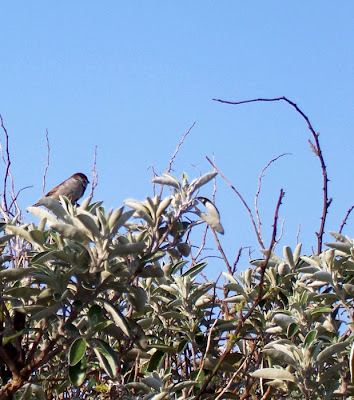
Passing a hedgerow, I managed to snap a shot of a male house sparrow, who seemed blissfully unaware of my presence.
I'll end this post with a shot of my little Shih Apso (Shih Tzu-Lhasa Apso hybrid), Jake, enjoying the view across Rhossili Bay.

If you haven't visited the Gower Peninsula yet, add it to your to-do list. You won't regret it!![Reblog this post [with Zemanta]](https://lh3.googleusercontent.com/blogger_img_proxy/AEn0k_sN0sQDeeZ1OpJY4GiX1623uDzVxScIokfoD80Jh2c3v01WT3ZfI3JNcgAitBJg3Dm508Dis-FixUuxthrRsp7jrF0L2Lfff5DlXMoHKLa6sdqtGLhkvyJR2-N2yEbSEOYONihmLX22j8Ry5SVBb2g=s0-d)
My main reason for heading to Rhossili, was to get some close shots of the Old Rectory. Alas, as on every other occasion I've tried to get such shots, the area close to the Rectory was overrun with cattle. I could see some walkers in the distance, who passed the cows without incident.

As I edged further along the path towards the Rectory, I decided not to risk passing the cows, as I had my little dog with me, and didn't know how he and the cows would react to one another. Cows can sometimes behave aggressively to dogs and their owners, so it was a risk I wasn't prepared to take.

I headed back uphill, passing this old building. For some reason, I had it fixed in my head that it's an old woollen mill, but further research suggests it's the old rocket shed, used by the Rhossili rocket crew, the forerunners of the present-day coastguard. If you're interested in shipwrecks around the Gower coast, I suggest you visit Chris Elphick's excellent Welcome to Gower site. He has numerous articles about the various shipwrecks and their visible remains, around the Gower coast.

Passing a hedgerow, I managed to snap a shot of a male house sparrow, who seemed blissfully unaware of my presence.

I'll end this post with a shot of my little Shih Apso (Shih Tzu-Lhasa Apso hybrid), Jake, enjoying the view across Rhossili Bay.

If you haven't visited the Gower Peninsula yet, add it to your to-do list. You won't regret it!
Gower Peninsula: Port Eynon in March
It's hard to believe that these shots were taken at Port Eynon in mid-March, just a few days ago. Temperatures were tolerable without a coat or sweater, too. The Gower Peninsula can be surprisingly warm at this time of the year, and holiday accommodation is much cheaper than when the holiday season is at its peak.
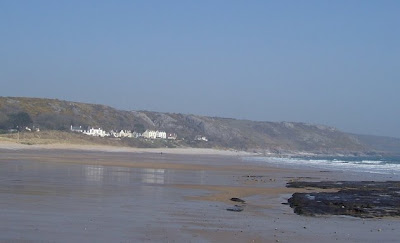
All the seafront shops, cafes and takeaways were open, so off-season visitors were well catered for. In fact, most of the cafes, etc, on Gower seem to open almost all-year round these days, something unheard of until a few years ago.

I absolutely love Port Eynon bay at this time of year. Sadly, it's a part of the Gower Peninsula that gets too crowded for my tastes during the summer. But provided you pick a nice, sunny day, Port Eynon can be a delightful and tranquil place to visit off-season, even in winter, or early spring, as it is now.![Reblog this post [with Zemanta]](https://lh3.googleusercontent.com/blogger_img_proxy/AEn0k_ul4vtGrcZY3IEgfxJRI3SBa1FLLYLuEjWWNvTTNw_b5QLoYafztorgu7C_izKyJGkLsyE9p4bjF_EOm1dVG3k2guFYSousF3-la14TBBNTlE0350PM74797iK35PBRzX2rQvXQU7jreoYKAvADcUOQ=s0-d)

All the seafront shops, cafes and takeaways were open, so off-season visitors were well catered for. In fact, most of the cafes, etc, on Gower seem to open almost all-year round these days, something unheard of until a few years ago.

I absolutely love Port Eynon bay at this time of year. Sadly, it's a part of the Gower Peninsula that gets too crowded for my tastes during the summer. But provided you pick a nice, sunny day, Port Eynon can be a delightful and tranquil place to visit off-season, even in winter, or early spring, as it is now.
Monday, 16 March 2009
Gower Peninsula: Spring Heeled Jack
A few years ago, I wrote an article about the apparent arrival of Spring-heeled Jack on the Gower Peninsula, mainly in the areas around Port Eynon, and Overton cliffs. I have reproduced the article, in its entirety, below, with the addition of some images not included in the original.
Introduction
Horatio Tucker was the first local historian to revive the memory of Spring-heeled Jack's activities on the Gower Peninsula, in fairly recent times. He recounted how an other-worldly apparition terrorised the inhabitants of Port Eynon and Overton, in his 1951 book, Gower Gleanings. The Gower Society investigated a little further, and Clifford Bevan gave the results of his findings in 'Spring-heeled Jack': A Nineteenth-century Gower Phenomenon. The article appeared in Volume 52 of the Gower Journal, published in 2001.
General Background
The Spring-heeled Jack phenomenon first manifested in London in the 1830s. Many theories were expounded as to Jack’s origins. Some believed he was an unearthly beast, others suggested he was from another planet, and others still thought he was the devil himself. More pragmatic Londoners suggested he was a man in a costume, carrying some kind of new-fangled, concealed apparatus which allowed him to leap great distances. He almost sounded like an evil, nineteenth century forerunner of James Bond.
 Popular depiction of Spring-Heeled Jack
Jack was described as tall, slender, and powerfully built, always clad in a black cloak. He was reputedly able to leap vertically in the air, as high as twenty or thirty feet, vaulting high walls, hedges and railings. Witnesses claimed the apparition possessed huge, pointy ears, and red, glowing eyes. He also reportedly spat blue-white flames at his victims.
His first attack was in Lavender Hill, south east London, in October 1837. He vaulted three metre high railings, and attacked a group of people, before conducting an act best described as an indecent assault. Jack tore the blouse off a woman in the group, and intimately fondled her. Another female victim claimed he kissed and fondled her, suggesting a rather more earthly motivation for his attacks, than a supernatural one. Spring-heeled Jack became notorious as his attacks increased, with rumours abounding that yet another woman had been blinded by the blue-white flames he spat at her. When he attacked a woman at Clapham, he left ground evidence which suggested he was using some kind of sprung apparatus to carry out his leaps.
At the start of 1838, Jack was declared a public menace by London’s Lord Mayor. A band of men formed to hunt him down, amongst their number an ageing Duke of Wellington. However, Jack eluded them and continued to terrorise women until 1843.
 Spring-heeled Jack, as depicted on the cover of a Penny Dreadful
In 1845, he resurfaced across the Atlantic, in New York City. He leapt at a prostitute, as she solicited for business on a bridge, breathing blue-white flames at her. She was so terrified, she leapt off the bridge to her death.
After the New York incident, Spring-heeled Jack retired for several years, until his re-emergence in 1877. He terrorised London yet again, before moving on to Aldershot camp, where he attacked a young soldier with his fiery breath. He moved on to Lincolnshire, and then made an appearance in Birmingham in 1879. All sightings of Jack were documented in the national, as well as local press.
Spring-heeled Jack arrives on Gower
Spring-heeled Jack arrived on Gower, late one autumn in the 1880s. Clifford Bevan, in his nineties at the time the article was published, relates how Jack made his debut one night when the moon was bright. Two farm lads at Overton Farm were the first to spot the fearsome figure. At the end of a hard day’s toil, the lads were no doubt cold, tired and hungry. As they stood at the bottom of a steep field, they looked up onto the field’s uppermost level, and saw a ghastly, black-cloaked apparition looming.
The countryside can seem most eerie when bathed in blue-white moonlight. Shapes innocent by day, distort into fanciful and terrifying creatures. Shadows of tiny objects take on huge and fearful proportions. Trees and bushes hold unknown terrors, as their skyward branches become the rapacious claws of crazed witches. Overton would have had no road lighting in the 1880s, or bright, electric house lights either, adding to the macabre and sinister illusion.
Rather than confront the unearthly apparition silhouetted atop the hill, the farm hands sped home, convinced Spring-heeled Jack was springing at their own heels. When they reached the farmhouse, they sought sanctuary in the ingle nook of the hearth, quaking with terror and refusing to emerge until daylight.
Their initial sighting triggered a whole spate of similar apparitions. High vantage points around Port Eynon and Overton, became Jack's theatre stages, where he performed to an aghast audience . His terrified witnesses watched as he leapt wildly over gates, hedges and other such constructions. So fearful was his performance, that women would not venture out at night, and some of the local farmers began searching for him, armed with shotguns.
However, Clifford Bevan's own father put an end to Jack’s reign of terror. Spotting the fiend one night, the elder Mr. Bevan chased him into a field. During a brief altercation, he discovered Jack to be no monster, but a local wag having some fun. Jack's fearsome black form was an illusion created with the aid of a stout oilskin coat and sou'wester. Not wishing to be exposed, 'Jack' threatened to beat his adversary with a heavy iron plough trace. To avoid the risk of serious injury or death, Mr. Bevan agreed not to expose him, but insisted he gave up his campaign of terror. 'Jack' agreed, and no more was seen of the monster on the Gower Peninsula.
News spread quickly across the peninsula, that the fearless Mr. Bevan had vanquished the monster. His victory was so celebrated that he found himself mobbed in the centre of Swansea, by unwitting Gower folk, who were relieved at Jack's demise.
When I first read Clifford Bevan’s article, I was a little disappointed, having searched for it for a long time. It was short, and there was no real phenomenon after all, just a prankster in a long coat. But disappointment soon turned to delight.
This little anecdote sheds an interesting light on the character of yesteryear's Gower. Life was very tough by today's standards, with many people, men, women and children, turning in twelve hour days, often longer, six or seven days a week. No wonder these people also chose to play hard. It was also a time when money was scarce, so many bargains were struck, e.g. "let me plant my potatoes in your field and I'll give you a sack or two in return". The bargain struck between Mr. Bevan and 'Jack' worked to both their advantages. 'Jack' went unpunished for his mischief, his identity remaining secret, and Mr. Bevan was hailed a hero for routing him.
Common sense dictates that the legend of Spring-heeled Jack is just a myth. The initial sightings suggest he was an unscrupulous prankster with a tendency towards sexual deviance. Coincidentally, he made his appearance at a time when pulp fiction, in a form known as the penny dreadful, made popular reading. These publications featured such unearthly and fearsome characters as Varney the Vampire and the Blue Dwarf, as well as Spring-heeled Jack himself. The popular fiction of the day would have acted as great PR for the man or men behind the legend of Spring-heeled Jack. Who knows, he or they may even have been inspired by such fictional tales. Whatever the truth of the situation, the culprit or culprits must have enjoyed many a laugh at the expense of terrified citizens. However, all it took on Gower, was a fearless and pragmatic farmer, to confront and unmask the local culprit as an ordinary man, and a cowardly one at that.
Reference
Clifford Bevan 'Spring-heeled Jack': A Nineteenth-century Gower Phenomenon. Gower Journal, vol. 52, 2001.
![Reblog this post [with Zemanta]](https://lh3.googleusercontent.com/blogger_img_proxy/AEn0k_tq7e0n373Ph0LnGLjf1E-z7W1HwK8TkEnATGiTDH0xSn-9XGKpK65pRqZCEkC-8pe-ecx61ADu-MIbYTfRfXH4yk0GrzUs4mZt5I-744O1MxGW278zRUrTsBWdYwZsmLRSnIBH7FV7zuuOce8zEfI=s0-d)
Introduction
Horatio Tucker was the first local historian to revive the memory of Spring-heeled Jack's activities on the Gower Peninsula, in fairly recent times. He recounted how an other-worldly apparition terrorised the inhabitants of Port Eynon and Overton, in his 1951 book, Gower Gleanings. The Gower Society investigated a little further, and Clifford Bevan gave the results of his findings in 'Spring-heeled Jack': A Nineteenth-century Gower Phenomenon. The article appeared in Volume 52 of the Gower Journal, published in 2001.
General Background
The Spring-heeled Jack phenomenon first manifested in London in the 1830s. Many theories were expounded as to Jack’s origins. Some believed he was an unearthly beast, others suggested he was from another planet, and others still thought he was the devil himself. More pragmatic Londoners suggested he was a man in a costume, carrying some kind of new-fangled, concealed apparatus which allowed him to leap great distances. He almost sounded like an evil, nineteenth century forerunner of James Bond.
 Popular depiction of Spring-Heeled Jack
Jack was described as tall, slender, and powerfully built, always clad in a black cloak. He was reputedly able to leap vertically in the air, as high as twenty or thirty feet, vaulting high walls, hedges and railings. Witnesses claimed the apparition possessed huge, pointy ears, and red, glowing eyes. He also reportedly spat blue-white flames at his victims.
His first attack was in Lavender Hill, south east London, in October 1837. He vaulted three metre high railings, and attacked a group of people, before conducting an act best described as an indecent assault. Jack tore the blouse off a woman in the group, and intimately fondled her. Another female victim claimed he kissed and fondled her, suggesting a rather more earthly motivation for his attacks, than a supernatural one. Spring-heeled Jack became notorious as his attacks increased, with rumours abounding that yet another woman had been blinded by the blue-white flames he spat at her. When he attacked a woman at Clapham, he left ground evidence which suggested he was using some kind of sprung apparatus to carry out his leaps.
At the start of 1838, Jack was declared a public menace by London’s Lord Mayor. A band of men formed to hunt him down, amongst their number an ageing Duke of Wellington. However, Jack eluded them and continued to terrorise women until 1843.
 Spring-heeled Jack, as depicted on the cover of a Penny Dreadful
In 1845, he resurfaced across the Atlantic, in New York City. He leapt at a prostitute, as she solicited for business on a bridge, breathing blue-white flames at her. She was so terrified, she leapt off the bridge to her death.
After the New York incident, Spring-heeled Jack retired for several years, until his re-emergence in 1877. He terrorised London yet again, before moving on to Aldershot camp, where he attacked a young soldier with his fiery breath. He moved on to Lincolnshire, and then made an appearance in Birmingham in 1879. All sightings of Jack were documented in the national, as well as local press.
Spring-heeled Jack arrives on Gower
Spring-heeled Jack arrived on Gower, late one autumn in the 1880s. Clifford Bevan, in his nineties at the time the article was published, relates how Jack made his debut one night when the moon was bright. Two farm lads at Overton Farm were the first to spot the fearsome figure. At the end of a hard day’s toil, the lads were no doubt cold, tired and hungry. As they stood at the bottom of a steep field, they looked up onto the field’s uppermost level, and saw a ghastly, black-cloaked apparition looming.
The countryside can seem most eerie when bathed in blue-white moonlight. Shapes innocent by day, distort into fanciful and terrifying creatures. Shadows of tiny objects take on huge and fearful proportions. Trees and bushes hold unknown terrors, as their skyward branches become the rapacious claws of crazed witches. Overton would have had no road lighting in the 1880s, or bright, electric house lights either, adding to the macabre and sinister illusion.
Rather than confront the unearthly apparition silhouetted atop the hill, the farm hands sped home, convinced Spring-heeled Jack was springing at their own heels. When they reached the farmhouse, they sought sanctuary in the ingle nook of the hearth, quaking with terror and refusing to emerge until daylight.
Their initial sighting triggered a whole spate of similar apparitions. High vantage points around Port Eynon and Overton, became Jack's theatre stages, where he performed to an aghast audience . His terrified witnesses watched as he leapt wildly over gates, hedges and other such constructions. So fearful was his performance, that women would not venture out at night, and some of the local farmers began searching for him, armed with shotguns.
However, Clifford Bevan's own father put an end to Jack’s reign of terror. Spotting the fiend one night, the elder Mr. Bevan chased him into a field. During a brief altercation, he discovered Jack to be no monster, but a local wag having some fun. Jack's fearsome black form was an illusion created with the aid of a stout oilskin coat and sou'wester. Not wishing to be exposed, 'Jack' threatened to beat his adversary with a heavy iron plough trace. To avoid the risk of serious injury or death, Mr. Bevan agreed not to expose him, but insisted he gave up his campaign of terror. 'Jack' agreed, and no more was seen of the monster on the Gower Peninsula.
News spread quickly across the peninsula, that the fearless Mr. Bevan had vanquished the monster. His victory was so celebrated that he found himself mobbed in the centre of Swansea, by unwitting Gower folk, who were relieved at Jack's demise.
When I first read Clifford Bevan’s article, I was a little disappointed, having searched for it for a long time. It was short, and there was no real phenomenon after all, just a prankster in a long coat. But disappointment soon turned to delight.
This little anecdote sheds an interesting light on the character of yesteryear's Gower. Life was very tough by today's standards, with many people, men, women and children, turning in twelve hour days, often longer, six or seven days a week. No wonder these people also chose to play hard. It was also a time when money was scarce, so many bargains were struck, e.g. "let me plant my potatoes in your field and I'll give you a sack or two in return". The bargain struck between Mr. Bevan and 'Jack' worked to both their advantages. 'Jack' went unpunished for his mischief, his identity remaining secret, and Mr. Bevan was hailed a hero for routing him.
Common sense dictates that the legend of Spring-heeled Jack is just a myth. The initial sightings suggest he was an unscrupulous prankster with a tendency towards sexual deviance. Coincidentally, he made his appearance at a time when pulp fiction, in a form known as the penny dreadful, made popular reading. These publications featured such unearthly and fearsome characters as Varney the Vampire and the Blue Dwarf, as well as Spring-heeled Jack himself. The popular fiction of the day would have acted as great PR for the man or men behind the legend of Spring-heeled Jack. Who knows, he or they may even have been inspired by such fictional tales. Whatever the truth of the situation, the culprit or culprits must have enjoyed many a laugh at the expense of terrified citizens. However, all it took on Gower, was a fearless and pragmatic farmer, to confront and unmask the local culprit as an ordinary man, and a cowardly one at that.
Reference
Clifford Bevan 'Spring-heeled Jack': A Nineteenth-century Gower Phenomenon. Gower Journal, vol. 52, 2001.
Sunday, 8 February 2009
Camera Critters: Poor Starfish

Poor old starfish. No fun in the sun for him or her - I found it on the beach at Port Eynon, on the Gower Peninsula. That's one of the less pleasant aspects of living near the coast - seeing dead marine life washed ashore.

Click here if you fancy taking part in Camera Critters, hosted by Misty.
![Reblog this post [with Zemanta]](https://lh3.googleusercontent.com/blogger_img_proxy/AEn0k_skx9oy2xMA9COsDIFsqXpxrd9rk3B6iYtBVpxJSmpJsEP-FrbxGXwQvrsuMcE4qsKsEh_hQm3nHqHCLpVX50xho8PTTZB6hQA_mwZn4Z9xV2nhVTNBK8J337654ia4UUzhKQKDOgd25wk7veZQWGwp=s0-d)
Monday, 26 November 2007
Gower Peninsula: Port Eynon Bay
Some more summer images from Port Eynon, on the Gower Peninsula. It was a very busy Saturday on the beach - and nice to see it being used for more than just barbecues and booze-ups.


![Reblog this post [with Zemanta]](https://lh3.googleusercontent.com/blogger_img_proxy/AEn0k_swwH37tjllBDJsHNJ2JpPEGWwgRPExZhY-Wab3PpkuofDDqHNDrHDyC2VANs3h-31Ozr_eEscach1Xd22Lmla2TbIGA4VbeCTMnmB7PkPQWVA88Ide4eo7o-cTfAuq6FM77bADsOXxyPVkUSX44F6L=s0-d)


Gower Peninsula: Dog days at Port Eynon
This fellow was certainly having fun in the sun. Here he is cooling off. He's not my dog, though - I'm not a doggy person.

This Weimeraner scared me a little when I first saw it. But it passed me without so much as a sniff or a glance.

![Reblog this post [with Zemanta]](https://lh3.googleusercontent.com/blogger_img_proxy/AEn0k_uTwkvgUTTXkphpGNsclh8TOGal_FSV8as5YSHFCZQ4C36uZjJO7TB4p0XoEwT-TXvGTF1rlHvuBU5qHxOWsk110RMq8toUuFI1r46slavEeLjGvTA7_AUwuzuwTDOePScbjmuxfuabLsrG-nDJvTdL=s0-d)

This Weimeraner scared me a little when I first saw it. But it passed me without so much as a sniff or a glance.

Gower Peninsula: Ball and chain at Port Eynon
These buoys usually bob about on the surface of the ocean at Port Eynon Bay. At low tide, they lie on the beach, patiently waiting for the tide to return.


Wednesday, 8 August 2007
Gower Peninsula: Fly & buttercup, Port Eynon
No, I'm afraid this isn't a pub review. There is no pub called the Fly and Buttercup anywhere on the Gower Peninsula - although I think it would be a pretty cool name for a pub. Earlier this year, I decided to try my hand at macro-photography, whilst waiting at the bus stop in Port Eynon.

Alas, it simply wasn't macro enough. Oh well, they say macro isn't mucho ...![Reblog this post [with Zemanta]](https://lh3.googleusercontent.com/blogger_img_proxy/AEn0k_uoOHZVZJktyNgw4zG8mPjq_j3GUbo8GCZKftPIVGkLEcqsG8R0XUgISkjpo3-twvCx6EEwgIFOTCEGuKkGappkx8x99VfcgpPlvbwF6Rqh0Zs3F8mAUfHtCwqG4Kns20q2tXyfg-Fwt3IPWL1hXNYJ=s0-d)

Alas, it simply wasn't macro enough. Oh well, they say macro isn't mucho ...
Cottage on Port Eynon beach
Possibly one of my favourite things about the Gower Peninsula, is all the interesting old houses I come across.

I'd love to know the history of this little cottage, which is right on the beach at Port Eynon. I don't even know its name, so I can't look up any local records. I suspect it may be a holiday home. If so, what a wonderful location.![Reblog this post [with Zemanta]](https://lh3.googleusercontent.com/blogger_img_proxy/AEn0k_vZeqZfw1XAm2JbvgA8wu4iJpsIyFBDfGTPlo5bAEbupsRYpzcTa3Q4FCqiVvbbmkhLjU7wRs1Qhq4sDWc-35wqc7IlZdz956Dt_ai2m1q3TXZq4NYJZ1wMiG6RZdKZwZ3-LzPHpnLf17d-UqRaxi_f=s0-d)

I'd love to know the history of this little cottage, which is right on the beach at Port Eynon. I don't even know its name, so I can't look up any local records. I suspect it may be a holiday home. If so, what a wonderful location.
The old salthouse at Port Eynon

It's often hard to get a shot of this, without people swarming all over it.
Monday, 14 May 2007
Sunset at Port Eynon
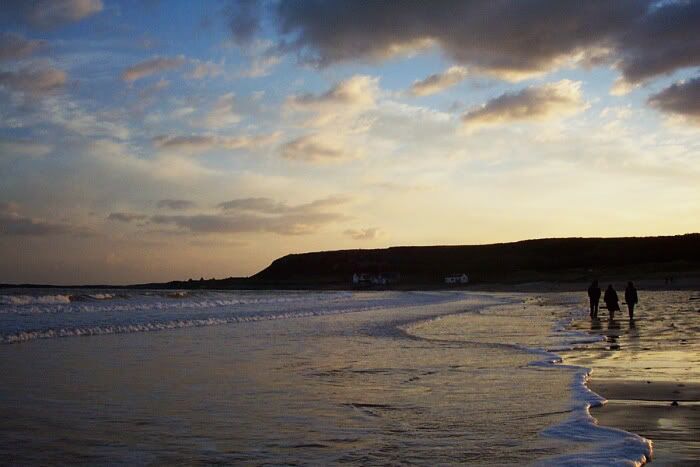
These shots show how the same beach developed an exotic, almost tropical quality during a late winter/early spring sunset. The heavy coats of the three walkers are the only things spoiling the illusion.

Once again, harsh sunlight makes the water look like mercury, whereas the wet sand reflects a burnished glow.

Once again, harsh sunlight makes the water look like mercury, whereas the wet sand reflects a burnished glow.

Sunday, 13 May 2007
Dusk at Port Eynon
Here's Port Eynon Bay again, this time at dusk, in February. The light this time is one of stark contrasts, soft in the shadows, glaring where the sun had free rein.
The gathering storm clouds didn't seem to trouble these fishermen.

This friendly sheep dog was equally unperturbed by the ominous skies.

The gathering storm clouds didn't seem to trouble these fishermen.
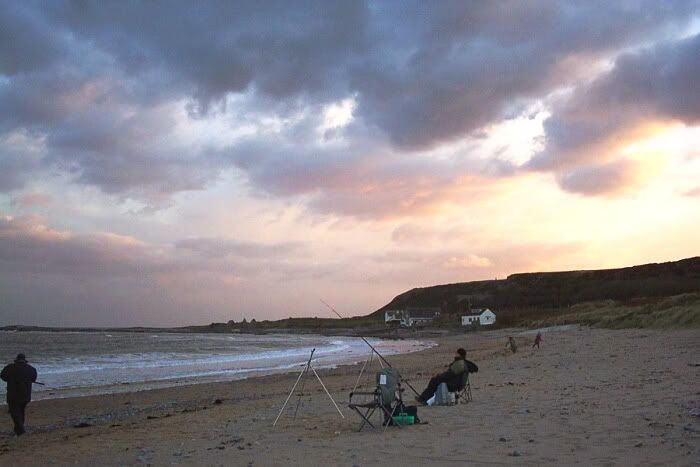
This friendly sheep dog was equally unperturbed by the ominous skies.

Saturday, 12 May 2007
Port Eynon by day
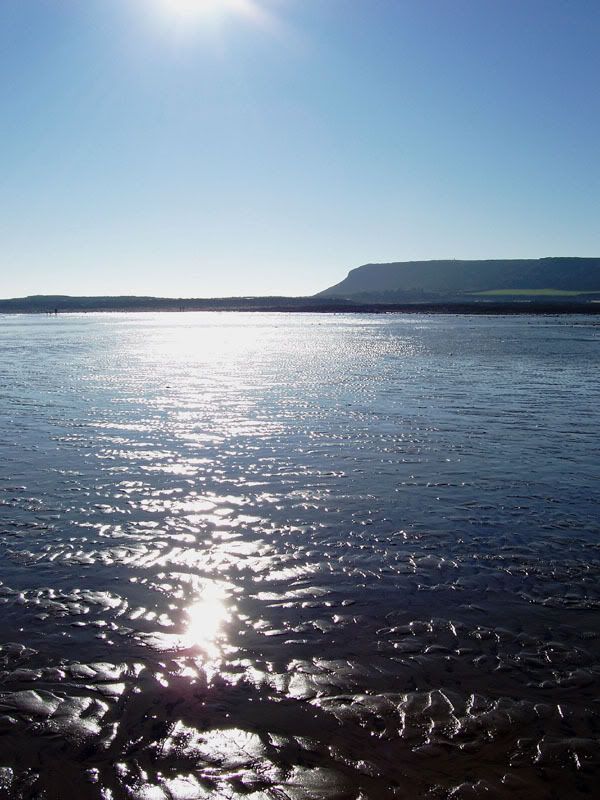
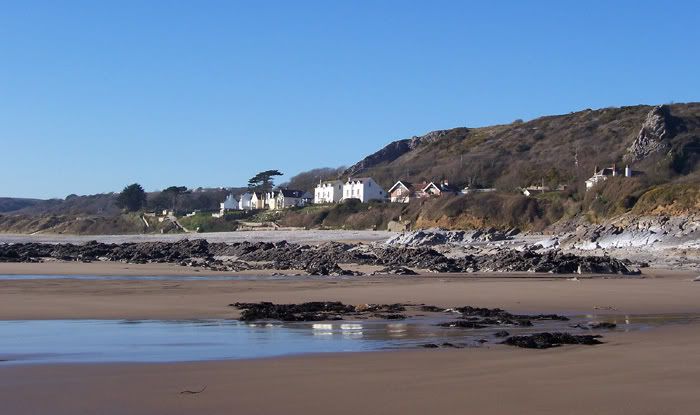
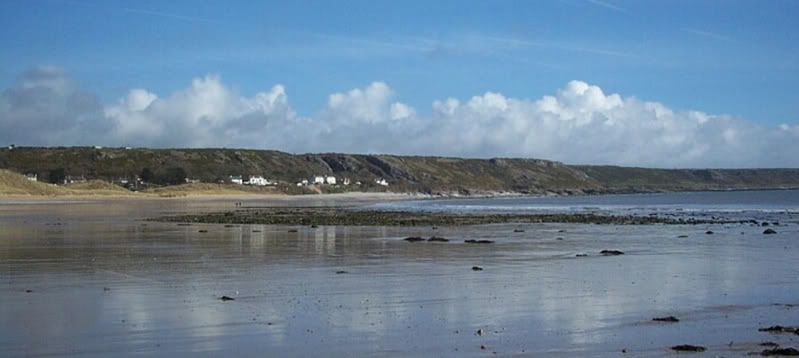
As a photographer, albeit an amateur one, I've always been fascinated by how the same landscape can look totally different, according to the weather, light conditions, time of day, etc. The first two shots of Port Eynon beach were taken mid-morning, in mid-winter.
The harsh sunlight produced some interesting reflections on the wet sand.

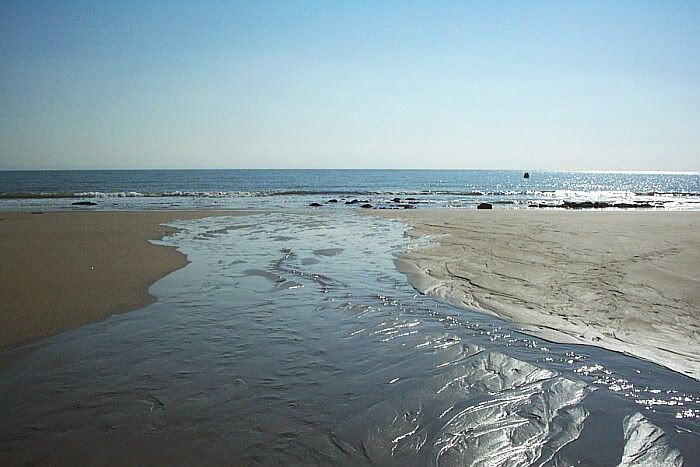
The stream that runs on to the beach at Horton, near the RNLI Lifeboat station, almost looked like mercury, in the same harsh light.

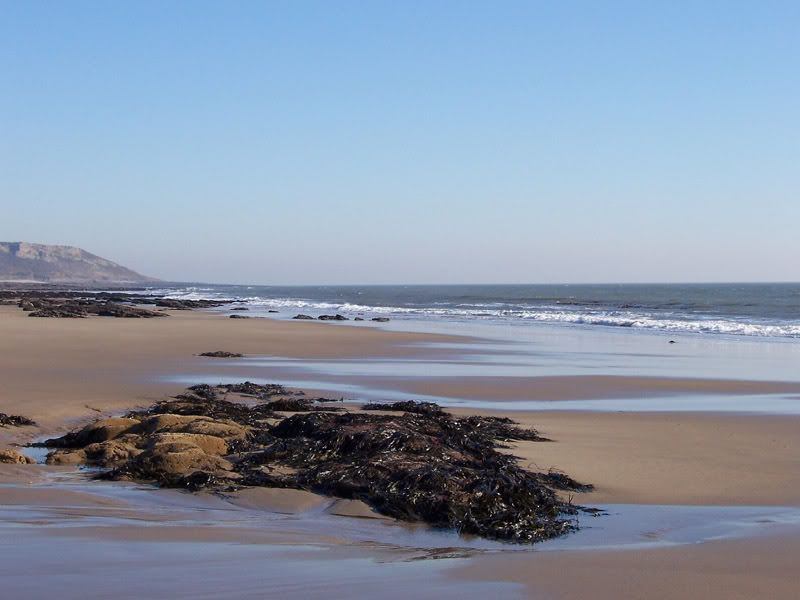
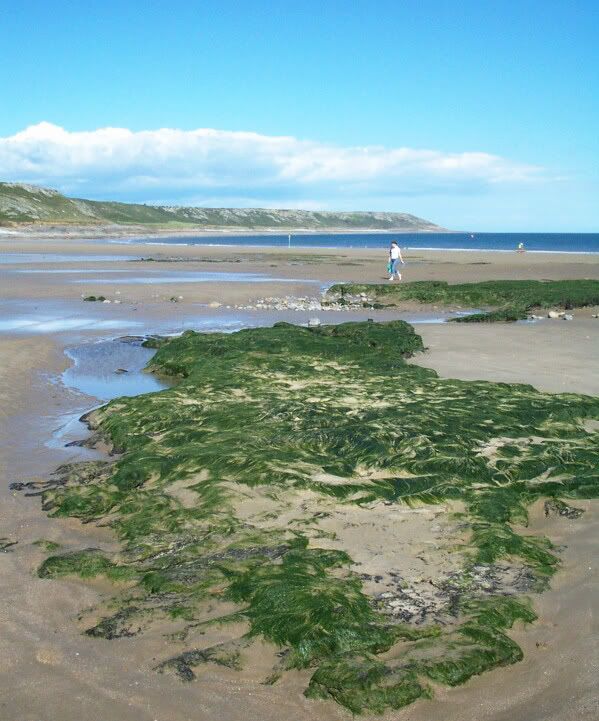
Full sun on a late summer afternoon, bathed the beach and its kelp beds in a much softer light. This shot almost has a retro feel to it, kind of like the retouched colour photography that was around in the 1950s.

The harsh sunlight produced some interesting reflections on the wet sand.
The stream that runs on to the beach at Horton, near the RNLI Lifeboat station, almost looked like mercury, in the same harsh light.
Full sun on a late summer afternoon, bathed the beach and its kelp beds in a much softer light. This shot almost has a retro feel to it, kind of like the retouched colour photography that was around in the 1950s.
Monday, 30 April 2007
Port Eynon minimalism
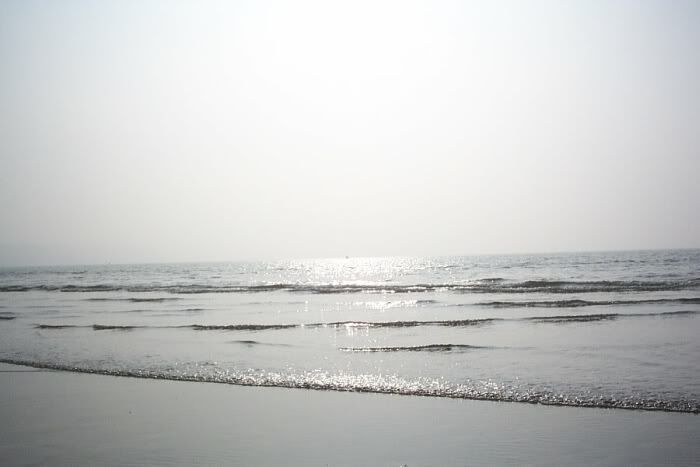
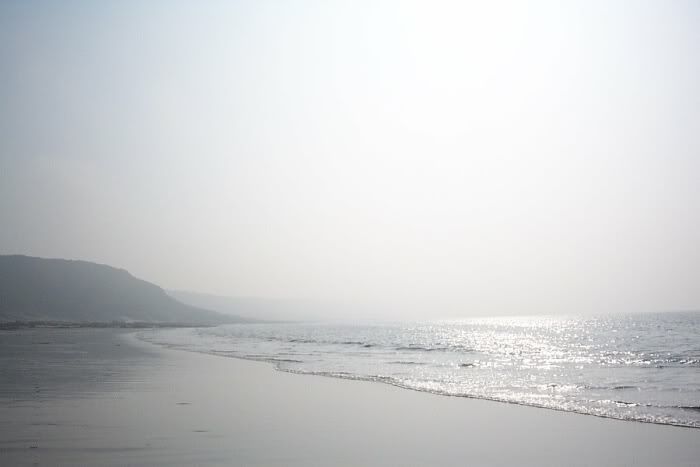
To most people, these images must seem pretty featureless. But I really like them for their minimalist simplicity. Although they look like greyscale images, they're actually colour shots taken early one hazy, misty morning, on the beach at Port Eynon. The special effects come courtesy of Mother Nature.